
One Person Is Now Doing Two Jobs
A practice owner recently described the situation this way: they are having a hard time replacing their second receptionist and would really like to take some of the phone strain off their single remaining staff member. They want integration with Weave and Nextech to schedule patients.
That is not an unusual story. It is, at this point, the normal story for specialty practices across dermatology, ophthalmology, cosmetic surgery, and dental. Healthcare administrative staffing has been under persistent pressure since 2020. Front desk roles have among the highest turnover rates in any healthcare category -- significant annual churn that varies by specialty, geography, and compensation conditions -- and the replacement cycle has lengthened.
When a second receptionist leaves, the first one absorbs the full call volume. That person cannot be in two places at once. Patients in the waiting room get attention. Calls go to voicemail, to hold music, or to a morning callback queue that did not exist last week. Within days, the Callback Trap takes hold: yesterday's missed calls become today's callback burden, which causes today's new calls to be missed, which creates tomorrow's callback burden.
At a dermatology practice or cosmetic surgery office, where a single missed new-patient call can represent a $10,000 to $15,000 procedure, this is not an administrative problem. It is a revenue problem.
What Hiring Another Person Actually Solves
The instinct is to post the job and wait. The problem is that posting the job solves none of the problems that made the last person leave.
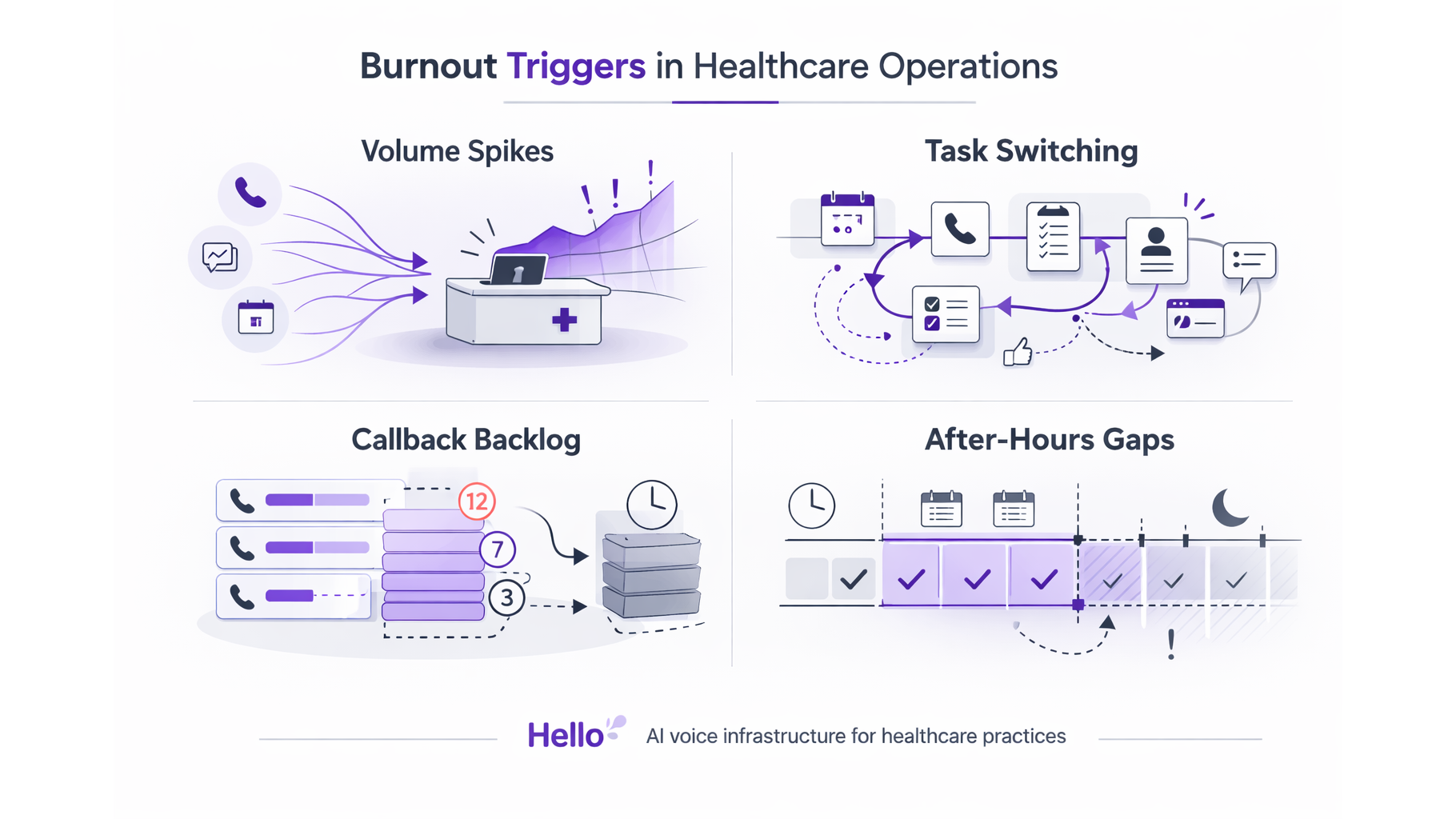
Front desk turnover in specialty healthcare practices is driven by a specific set of conditions: call volume that exceeds what one person can manage, constant task switching between answering phones and assisting patients in the office, the mental overhead of a callback backlog that never empties, and after-hours coverage gaps that create a fresh pile of voicemails every morning. A new hire walks into the same conditions. The cycle repeats.
Beyond turnover, there is the knowledge problem. Every receptionist who leaves takes institutional knowledge with them: which patients get priority routing, how a particular provider prefers their schedule organized, which insurance combinations require extra verification time, which caller names belong to surgical patients who need to be flagged. That knowledge was not documented anywhere. It lived in one person's memory. Now it is gone.
A second receptionist also cannot cover nights, weekends, or lunch. They handle one call at a time. They get sick, take vacations, and eventually leave again. The problem with hiring is that it addresses the head count while leaving the infrastructure unchanged.
The Infrastructure Problem
The framing that most clearly describes what is actually happening: the practice has an infrastructure gap, not a staffing gap.
The phone system generates more work than one or two people can sustainably handle. That is not a reflection of the staff's capability. It is a reflection of the fact that the phone system was designed for a different call volume, and it has no mechanism for handling demand that exceeds human bandwidth.
A practice at 600 to 1,500 inbound calls per month, which is a moderate volume for a specialty practice, generates 30 to 75 calls per business day. On a busy day, that number spikes. During lunch coverage and after business hours, those calls go to voicemail or hold. The morning brings a pile of messages from patients who called at 6 PM, some of whom have already called a competitor.
No number of receptionists makes that problem go away entirely. The economics of the phone system are working against the practice.
Hello Voice handles inbound call volume 24 hours a day, seven days a week, without breaks, PTO, or turnover. A single front desk coordinator earning $45,000 per year costs the practice roughly $55,000 to $65,000 when benefits, payroll taxes, and onboarding are included. That same position covers business hours only and handles one call at a time.
What AI Actually Replaces (And What It Does Not)
This is the part that is most often misunderstood, so it deserves a direct answer.
Hello Voice replaces the phone volume. It answers every inbound call 24 hours a day, identifies the caller, classifies their intent, books appointments directly into the practice management system, collects deposits for high-value procedures, and routes clinical or urgent calls to the appropriate human. It does not take messages that require follow-up. It resolves calls end-to-end during the call.
Hello Voice does not replace the human who greets patients in the office, manages check-in, handles in-person concerns, or makes the judgment calls that require reading a room. The person standing at the front desk, talking to a patient who just had a procedure, provides something that a phone agent cannot. The goal is not to eliminate that role. It is to make sure that person is not also simultaneously drowning in a phone queue.
The practices that see the clearest improvement from Hello Voice are the ones where the front desk staff has been stretched too thin by call volume. When the phone work is handled, the in-person work gets better. Patients in the office get more attention. Staff often find the role more manageable when phone volume is no longer the dominant stressor.
The Knowledge Problem, Solved Differently
The institutional knowledge issue has a different answer with AI infrastructure than it does with a new hire.
During implementation, Hello's team works with the practice to configure the agent's routing logic, scheduling rules, VIP patient flags, provider preferences, and insurance handling. That configuration is documented in the system. It does not live in one person's memory. When a staff member leaves, the configuration stays.
New staff members do not need to be trained on how to handle the phones, because the phones are handled. They need to be trained on the in-person work, the clinical support, and the judgment calls that are genuinely theirs to make. That is a shorter and more stable onboarding arc than training someone to manage a full call volume alongside everything else.
Integration with Your Existing Systems
The practical question most practices ask first: will it work with what we already use?
Hello integrates with a broad range of EHR and practice management systems, including Nextech, athenahealth, ModMed, DrChrono, and Booker/MINDBODY. For practices using Nextech specifically, Hello reads patient records, checks schedule availability, and writes appointments directly into the system. No manual re-entry. No staff workaround.
For practices using Weave as their communication platform, Hello operates alongside it rather than replacing it. Weave handles communication routing and messaging. Hello handles the inbound call volume and the scheduling workflows. The two systems address different parts of the front desk problem and do not conflict.
For practices using online scheduling tools like NextPatient for web-based bookings, Hello handles the phone channel and routes high-intent callers through the same booking flow your online scheduling uses. Patients who call at 8 PM get the same quality of scheduling experience as patients who book online during business hours.
What Implementation Looks Like
Implementation is done for you. The typical timeline from contract to live is 10 business days. During that period, Hello's team configures the agents, sets up the EHR integration, builds out the routing logic specific to the practice, and tests everything before going live.
The remaining receptionist does not manage the setup. They do not need to learn a new configuration tool. They need to know that the phones are covered and that calls requiring their attention will be routed to them directly.
The 90-day minimum commitment gives the practice time to see the full picture: call volume covered, callback queue eliminated, after-hours patients handled, and staff operating at a different level of sustainability. At that point, practices can evaluate the outcome on their own terms.
See How Hello Works at a Practice Like Yours
A practice audit takes 30 minutes. You will see how Hello would integrate with your current Nextech or EHR setup, what the call-handling configuration would look like for your specific routing needs, and what the economics work out to at your current call volume.
Schedule a Practice AuditThe Actual Question Worth Asking
When a practice cannot fill the second receptionist role, the immediate response is to post the job again and manage in the meantime. That is reasonable. But the meantime has a cost: calls missed, revenue not captured, a remaining staff member working under conditions that lead to the same turnover that created the problem.
The more useful question is whether the practice's phone infrastructure was ever designed to run on two people, and what it would look like if it did not have to be. A second receptionist fills a head count. AI voice infrastructure addresses the underlying capacity problem so that the people who work in the practice are doing the work that actually requires them.
The practices getting the most out of Hello Voice are not the ones trying to eliminate staff. They are the ones that could not hire fast enough to keep up with their call volume and decided to stop making their existing team absorb the difference.
Frequently Asked Questions
Does Hello replace front desk staff entirely?
No. Hello handles inbound call volume, appointment booking, deposit collection, and follow-up workflows so your existing staff can focus on patients in the office rather than managing a phone queue. It covers the operational load that causes burnout and turnover, not the in-person care work that requires a human.
Will Hello work with the systems my practice already uses?
Hello integrates natively with more than 37 EHR and practice management systems, including Nextech, athenahealth, ModMed, and DrChrono. It works alongside communication platforms like Weave without requiring you to replace your existing stack. Implementation is done for you in 10 days.
What happens to the institutional knowledge when a receptionist leaves?
Hello's AI agents are configured during implementation with your practice's specific routing logic, scheduling rules, VIP patient flags, and provider preferences. That configuration does not walk out the door when a staff member leaves. The knowledge lives in the system, not in any one person's memory.
How long does it take to set up Hello at our practice?
Most practices are live in 10 business days. The implementation is done for you: Hello configures the agents, sets up the EHR integration, tests the routing logic, and verifies everything before going live. Your staff does not need to learn a new system or manage a technical setup.
Is this HIPAA compliant?
Yes. Hello signs a Business Associate Agreement with each customer practice before PHI is processed. Runtime HIPAA compliance scanning via Mercury (Hello's compliance control plane) provides encrypted transcript storage with 6-plus year retention and immutable audit trails. The compliance infrastructure is built into every Hello Voice deployment.