
The Bottom Line
Your practice is losing $125,000+ annually to the Callback Trap.
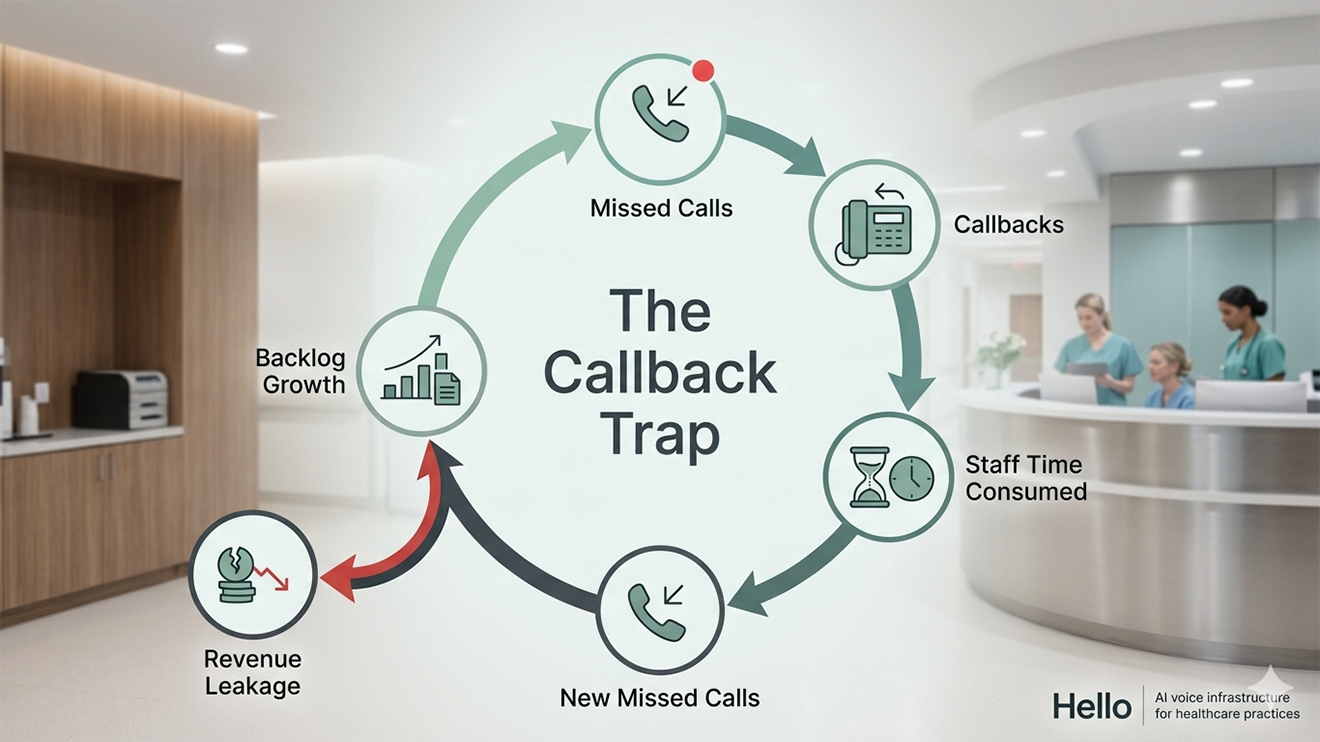
Every missed call becomes a callback. Every callback consumes staff time. Every consumed hour means more missed calls. The loop compounds until your contact rate permanently degrades and revenue leaks.
The fix isn't more staff. It's infrastructure that never misses a call.
Executive Summary
The "Callback Trap" is an operational failure state where practice staff consume their available bandwidth returning yesterday's missed calls, leaving them unable to answer today's incoming leads. This cycle results in a permanently degraded contact rate, staff burnout, and significant revenue leakage. It is not solved by hiring more humans; it is solved by decoupling lead capture from staff availability.
What is the Callback Trap?
The Callback Trap is not a staffing issue. It is a timing issue. Patients and prospective leads call when their intent is highest. If your practice responds hours later, you are competing against whatever happened next in their life: a competitor answered, the patient got distracted, or the urgency passed. This is exactly why dermatology clinics are replacing answering services with AI receptionists that book appointments in real time instead of taking messages.
The Callback Trap: The loop where your staff is so busy returning yesterday's missed calls that they miss today's new patient inquiries, creating a compounding backlog of low-value work.
The Physics of Failure: Why Staff Cannot Win
Most Practice Administrators attempt to solve this by hiring another receptionist. This rarely works because the Callback Trap is driven by spiky volume, not total volume.
1. Volume Spikes vs. Static Staffing
Call volume in medical practices is rarely linear. It follows a "camel hump" distribution: massive spikes on Monday mornings, post-lunch, and immediately after work hours. Human staffing, however, is static. If you have three receptionists but eight concurrent calls at 9:05 AM, five calls go to the trap. You cannot afford to staff for the peak 24/7.
2. The "Context Switching" Tax
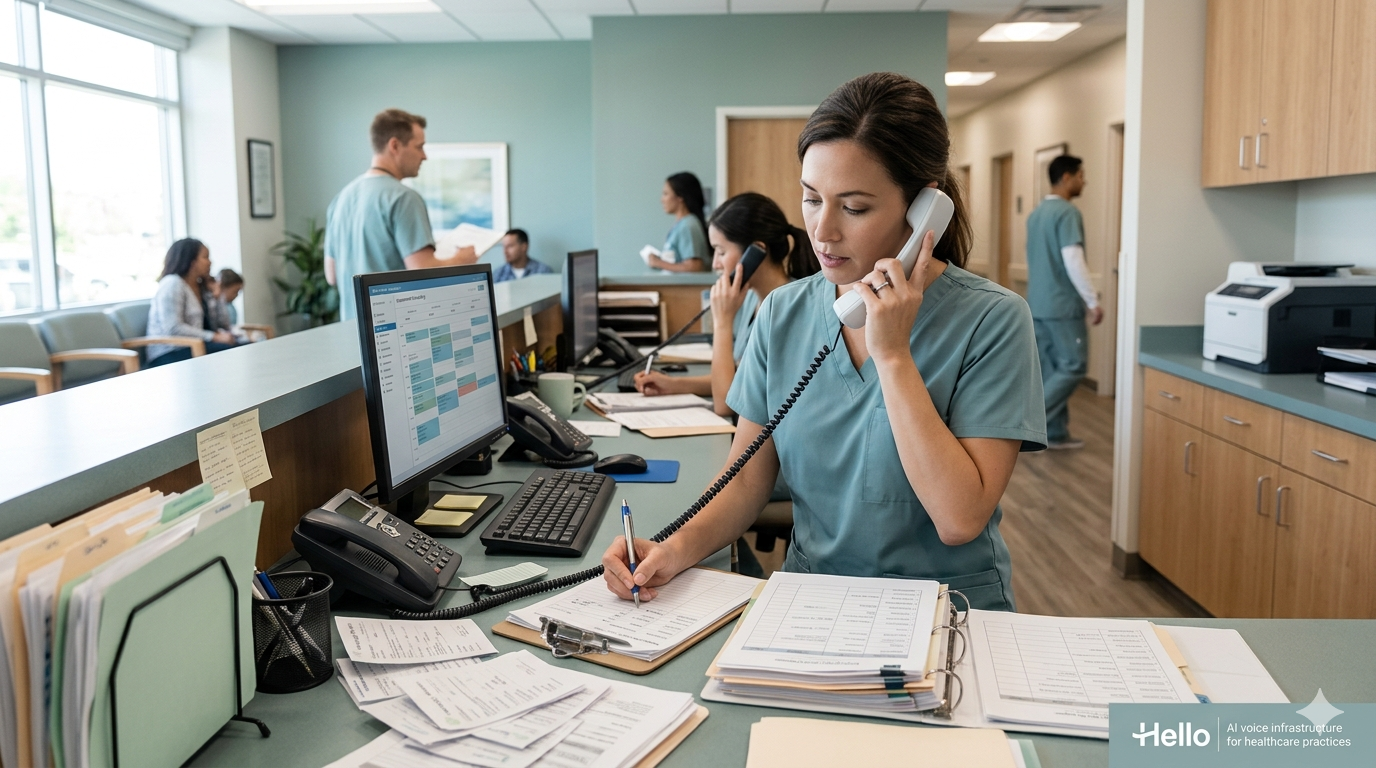
When a front desk staff member stops checking in a patient to answer a ringing phone, the in-person experience degrades. When they ignore the phone to help the patient, the caller goes to voicemail. The "Callback Trap" is the result of forcing staff to choose between the patient in front of them and the patient on the phone. Inevitably, the phone loses.
Why the "Call Them Back Later" Strategy Fails
Returning missed calls sounds reasonable until you look at the data. By the time your team calls back, the patient is often unavailable, leading to a game of phone tag that consumes even more staff time.
| Metric | Instant Answer (AI) | Manual Callback (Human) |
|---|---|---|
| Speed to Lead | < 5 Seconds | 2–4 Hours (Average) |
| Contact Rate | 100% | ~40% (Voicemail tag) |
| Patient Perception | "Responsive & Modern" | "Hard to reach" |
| Booking Probability | High | Low (Competitor likely secured) |
Benchmark notes and sources:
- Lead-response latency materially reduces contact and conversion rates as delay increases. Source: Harvard Business Review, “The Short Life of Online Sales Leads”.
- Practices should treat callback contact rates as a measured operational KPI and replace generic assumptions with PMS/call-system data segmented by daypart and source.
- The table values are planning benchmarks for operational modeling; calibrate with your own call logs and booking outcomes before setting revenue forecasts.
The Revenue Math: Calculating Leakage
The cost of the Callback Trap is often hidden in the "Unbooked" column of your Practice Management Software (PMS). However, the math is straightforward. If a new patient Lifetime Value (LTV) is $1,500 and you miss just 5 new patient calls a day:
5 Missed Calls × 40% Contact Rate on Callback = 3 Lost Patients/Day.
3 Lost Patients × $1,500 LTV = $4,500 in Future Revenue Lost Daily.
This is why "hiring more staff" is often too slow. The revenue is leaking now. Use the Hello ROI calculator to model your specific volume and see the impact of recovering just 50% of these calls. For a detailed breakdown of the full financial picture, including the hidden costs your answering service invoice does not show, see the true cost of a medical answering service in 2026.
Diagnostic Checklist: Are You in the Trap?
If you are unsure if your practice is suffering from this operational drag, check for these symptoms:
- Do you start the week with more than 15 voicemails stacked up from the weekend?
- Is your front desk still playing phone tag at 4 PM instead of preparing for tomorrow?
- Are new patient bookings flat despite increased marketing spend? That usually means your bucket has a hole in it.
- Does your reception team complain about "never catching up"?
How to Break the Loop with Elastic Capacity
High-growth practices are moving away from the "Callback Model" entirely. Instead of managing voicemails, they are deploying AI receptionist solutions with elastic capacity. For a full comparison of how these systems differ from the traditional answering services that create the callback trap in the first place, see AI answering service vs. traditional medical answering service.
To break the trap, you must decouple lead capture from human availability. An healthcare AI voice infrastructure ensures that:
- Whether 1 caller or 50 callers ring at once, everyone is answered immediately.
- Every call intent is logged, appointments integrate directly into your PMS, and urgent clinical needs are routed to nurses.
- Your human team handles high-empathy, complex tasks while the infrastructure handles routine intake and scheduling.
- 100% of calls answered in under 5 seconds, 24/7
- Direct PMS/EHR integration for real-time appointment booking
- Secure deposit capture at the time of booking to reduce no-shows
- No missed calls means no callback trap
FAQ
Can AI really handle complex medical scheduling? Yes. Hello's AI voice platform integrates directly with your PMS/EHR and handles appointment booking, rescheduling, cancellations, and payment collection. It also runs full patient intake over the phone, including insurance verification and clinical history collection. For complex cases, it transfers to your staff. Practices considering AI often ask whether patients trust AI receptionists. The data shows trust depends on resolution speed and accuracy, not whether a human is on the line. If your current answering service is contributing to the trap rather than solving it, see why your medical answering service may be losing you patients.
What happens to my existing front desk staff? Your team focuses on high-value, high-empathy tasks like complex patient needs and in-person check-ins. Hello handles the repetitive, high-volume phone work that creates the callback trap.
Is Hello HIPAA compliant? Yes. Hello signs a Business Associate Agreement (BAA) and maintains enterprise-grade security for all patient communications. For a detailed look at what separates real compliance infrastructure from paper compliance, see how secure is an AI receptionist for sensitive business calls. Practices handling substance use disorder patients should also review the 2026 changes to 42 CFR Part 2 that now align Part 2 enforcement with HIPAA.
The solution is not to work harder at callbacks. It is to stop missing the call in the first place.