

The Bottom Line
Dermatology patients do not reject AI. They reject AI that replaces their physician. When AI augments the care experience by answering calls instantly, routing skin cancer concerns to clinical staff, and handling routine scheduling, patients rate the experience higher than the traditional alternative.
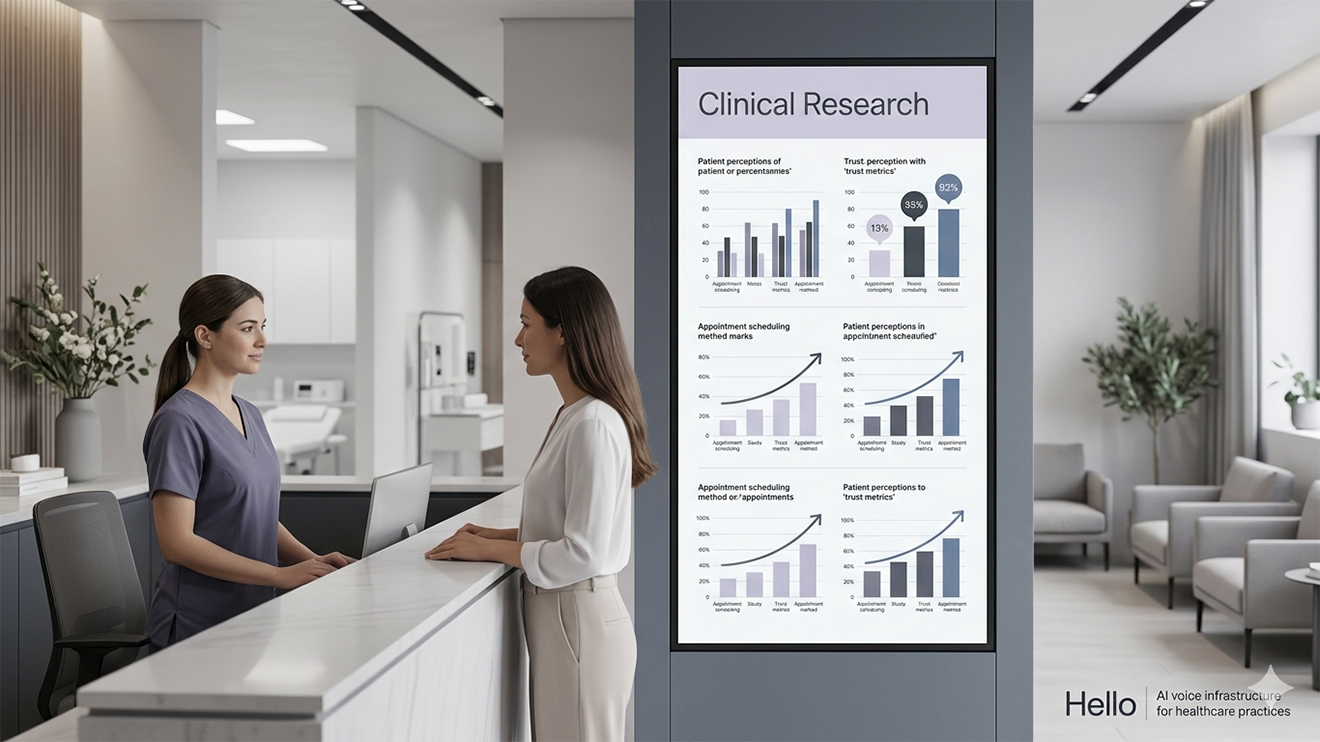
What the Clinical Research Actually Shows
The assumption that patients will reject AI in healthcare is widespread. The clinical evidence says otherwise, and the nuance matters.
A cross-sectional study published in 2025, conducted among 130 adults at a US academic dermatology clinic, examined patient perceptions of AI across multiple care modalities. The findings directly challenge the "patients want humans only" assumption that holds many practices back from adopting AI-assisted workflows.
73.8% of patients trusted dermatologist-guided AI. Patients rated AI-assisted visits highest in perceived quality, even though they reported being most comfortable with dermatologist-led care. Only 1.5% trusted standalone AI apps operating without physician involvement.
This distinction is critical for understanding where AI fits in dermatology operations. Patients do not want AI replacing their dermatologist. They want AI making the experience of accessing their dermatologist faster, smoother, and more responsive. An AI receptionist that answers calls instantly, routes skin cancer concerns to clinical staff immediately, and handles routine cosmetic scheduling without hold time is precisely the model patients prefer: technology supporting the physician relationship, not substituting for it.
The equity consideration
The study also revealed an important equity finding. Patients with greater technology experience reported higher acceptance of AI-assisted care, while Black patients and those with darker skin tones reported significantly lower acceptance. For dermatology practices serving diverse populations, this means an AI receptionist must be positioned as a tool that improves access and speed, with transparent routing to human staff for any patient who requests it. The option to reach a person must always be immediate and clearly communicated.
Patients want instant responsiveness and they want physician involvement. These are not contradictory. An AI receptionist delivers the first and enables the second by freeing clinical staff from administrative phone burden. The result is a practice that feels more accessible and more attentive simultaneously.
The Dermatology Context-Switching Problem
A dermatology front desk is unlike any other in healthcare. In a single hour, a receptionist might field a call about a suspicious mole biopsy result, schedule three Botox appointments, verify insurance for a Mohs surgery referral, answer a question about post-laser care instructions, and handle a new patient asking whether you accept their plan. Each of those calls carries different urgency, different emotional weight, and different revenue implications.
Unlike a single-specialty practice, dermatology front desks manage two fundamentally different call types. Medical derm calls (biopsy results, skin cancer screening follow-ups, urgent rashes, prescription refills) carry clinical urgency and compliance requirements. Cosmetic derm calls (Botox scheduling, chemical peel pricing, laser consultation requests) carry revenue urgency. A traditional answering service has no mechanism to distinguish between a patient calling about a melanoma biopsy and a patient asking about filler pricing. Both get the same script. Both get the same hold time. One of them should not be waiting. The operational and financial gap between message-taking and call resolution is detailed in our comparison of AI and traditional answering services.
Dermatology practices operate on a blended model where cosmetic revenue often subsidizes the lower reimbursement rates of medical derm. When cosmetic inquiries go unanswered, the revenue that supports the entire practice erodes. When medical follow-ups get delayed, clinical outcomes and patient trust suffer simultaneously.
Practices cover roughly 40 of the 168 hours in a week. That means 76% of the time, every incoming call goes to voicemail. And 85% of those callers will not leave a message. They call someone else. For a dermatology clinic where patient lifetime value ranges from $3,000 to $5,000, missing just 10 calls per week translates to $150,000 to $250,000 in annual revenue loss. The true cost of a medical answering service extends well beyond the monthly invoice when you factor in this lost revenue. Dental practices face a similar challenge with patient no-shows, where deposit collection and 24/7 rescheduling are producing 40%+ reductions.
The Five Call Types That Define the Dermatology Patient Experience
Understanding why AI receptionists outperform answering services requires understanding the specific call types that dermatology front desks manage daily. Each carries different urgency, different information requirements, and different revenue implications.
1. Skin cancer screening and biopsy follow-ups
These calls carry the highest clinical urgency. A patient calling about a biopsy result is anxious. A patient calling to schedule a skin check after finding a suspicious lesion needs to feel heard immediately. Routing these calls to voicemail erodes trust. An AI receptionist identifies the clinical nature of the inquiry, collects the relevant details, and escalates to clinical staff with priority flagging. The patient receives an immediate acknowledgment that their concern is being handled, not a message machine.
2. Cosmetic consultation requests
Botox, fillers, chemical peels, laser treatments, and body contouring consultations are the revenue engine of most dermatology practices. These callers are often comparison shopping. If they reach voicemail, they call the next clinic in their search results. An AI receptionist that books the consultation in real time, collects a deposit if applicable, and confirms the appointment via text captures revenue that voicemail loses.
3. Prescription refill requests
Refill calls are high-volume, low-complexity, and a constant drain on front desk bandwidth. They require collecting patient name, medication, pharmacy, and urgency level. An AI receptionist handles this intake efficiently, packages the information for clinical review, and routes it without consuming staff time.
4. Insurance verification and new patient intake
New patient calls require collecting insurance details, verifying coverage, and confirming appointment availability. These are the longest calls and the most administratively intensive. Automating the structured data collection portion while routing complex insurance questions to staff creates immediate time savings. For a detailed look at how AI voice agents handle the full intake workflow, including EHR write-back and eligibility checks, see how AI voice agents improve patient intake for medical practices.
5. Post-procedure care questions
Patients recovering from laser treatments, chemical peels, or minor surgical procedures frequently call with questions about normal healing, side effects, and activity restrictions. An AI receptionist trained on post-procedure protocols can provide accurate standard care guidance while flagging genuine complications for immediate clinical attention.
The Dermatology Busy Season Problem
Dermatology call volume is seasonal. Pre-summer (April and May) brings a surge in skin check requests and cosmetic treatments for preparation. Post-summer (September) brings another wave as patients seek treatment for sun damage, hyperpigmentation, and acne flare-ups from sunscreen-clogged pores. These seasonal peaks overwhelm front desks that are staffed for average volume.
An AI receptionist scales instantly. There is no recruiting, no onboarding, no training period. When call volume spikes 40% in April, the AI handles 40% more calls without any operational disruption. When volume normalizes in July, there is no idle capacity to manage. This elasticity is impossible with human staffing and represents one of the strongest economic arguments for AI in seasonal-demand specialties like dermatology.
What Implementation Actually Looks Like
The transition from a traditional answering service to an AI receptionist is not a multi-month project. A done-for-you implementation follows a structured process: the platform provider audits the practice's current call patterns, maps the EHR/PMS integration requirements, configures the voice agent with dermatology-specific protocols, and deploys in production within 10 business days. There is no disruption to existing phone lines or patient workflows during the transition.
The optimization period that follows deployment is where the system improves. Call recordings are reviewed, routing logic is refined, and the voice agent's responses are calibrated to match the practice's tone and terminology. A cosmetic-focused practice in Scottsdale sounds different from a medical derm clinic in Boston. The AI adapts to reflect that.
For practices running on PMS systems common in dermatology (ModMed, Nextech, EMA, DrChrono), integrations ensure that appointments booked by the AI appear in the same scheduling system staff use daily. If an integration gap exists for a specific system, the implementation team builds it. That commitment to integration completeness is non-negotiable because an AI receptionist that cannot write to the scheduling system creates more work, not less.
The Economics of Switching
Traditional answering services bill per minute. For a dermatology practice with 500+ calls per month, that cost is unpredictable and scales linearly with volume. An AI receptionist operates on a fixed monthly model that includes all call volume, all after-hours coverage, and all scheduling automation. The practice gains cost predictability and operational capacity simultaneously.
A dermatology practice averaging 800 calls per month, with 35% occurring after hours, sends approximately 280 calls per month to voicemail. At an 85% voicemail abandonment rate, that is 238 callers per month who never leave a message. If even 15% of those abandoned calls represented bookable appointments at an average appointment value of $400, the practice loses over $171,000 annually in unrealized revenue. The AI does not need to capture all of it. It needs to capture enough to make the ROI obvious.
The more significant economic impact is not the cost of the AI versus the cost of the answering service. It is the revenue recovery from calls that previously went unanswered. A single cosmetic consultation booked at 8:47 PM on a Wednesday, for a $3,500 laser resurfacing treatment, generates more revenue than several months of AI receptionist fees. Multiply that across the 30 to 40% of call volume that occurs outside business hours and the ROI resolves itself quickly. View pricing details.
What to Evaluate Before Choosing an AI Receptionist for Dermatology
Not every AI receptionist platform is built for dermatology. The evaluation criteria that matter for this specialty are specific:
- Can the AI write directly to your scheduling system (ModMed, Nextech, DrChrono, AdvancedMD), or does it generate messages that staff must manually re-enter? View all integrations.
- Can the system differentiate between a biopsy follow-up call and a Botox inquiry, with configurable urgency tiers and the ability to page the on-call provider for after-hours clinical emergencies?
- The platform must sign a Business Associate Agreement (BAA) and maintain strong encryption in transit and at rest, with post-quantum-ready key management, full audit logging, and SOC 2 Type II compliance. A BAA alone is not enough. Understanding what real AI security infrastructure looks like is essential before selecting a vendor.
- Self-serve platforms transfer the configuration burden to a practice team that is already overwhelmed. Look for done-for-you implementations that deliver production-ready results without consuming staff bandwidth.
- Request a live demo call. The voice should sound natural, conversational, and unhurried. Patients calling about sensitive concerns like skin cancer or cosmetic insecurities will disengage from a voice that sounds robotic or rushed.
- If your patient population includes Spanish speakers, the AI must handle calls fluently in both languages without relying on a third-party translation relay.
FAQ
Do dermatology patients accept AI receptionists? Yes. A 2025 cross-sectional study of 130 adults at a US academic dermatology clinic found that 73.8% of patients trusted dermatologist-guided AI. Patients rated AI-assisted visits highest in perceived quality. The key factor is that AI augments the dermatologist's care rather than replacing it.
How much revenue do dermatology clinics lose from missed calls? With an average patient lifetime value of $3,000 to $5,000, missing just 10 calls per week translates to $150,000 to $250,000 in annual revenue loss. After-hours and weekend calls represent 30 to 40% of total call volume, and 85% of callers who reach voicemail will not leave a message.
What is the callback trap in dermatology practices? The callback trap occurs when front desk staff spend their mornings returning yesterday's missed calls, which causes them to miss today's new patient inquiries. In dermatology, this is amplified because staff must context-switch between medical derm urgencies (biopsy results, skin cancer screenings) and cosmetic scheduling (Botox, chemical peels, laser treatments). Practices handling SUD or behavioral health patients should also be aware of the 2026 changes to 42 CFR Part 2 that affect how AI systems can process sensitive patient data.
The question is not whether dermatology patients trust AI. The clinical evidence answers that. The question is how long a practice can afford to send 76% of its weekly call volume to voicemail while the evidence, the economics, and the patient experience all point in the same direction.