
The Bottom Line
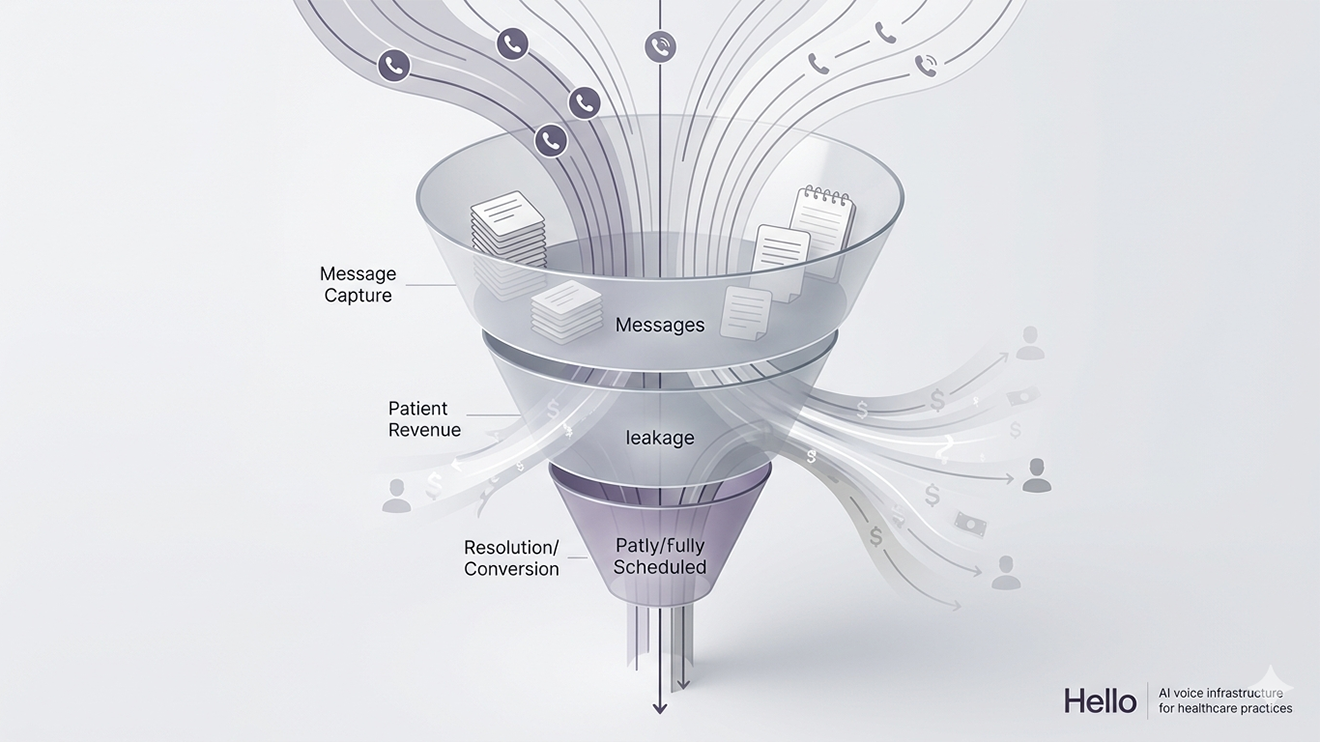
A busy dermatology practice loses $84,000+ per year to unanswered phone calls. Not because they lack patients. Because they cannot pick up the phone fast enough.
31% of inbound calls to healthcare practices go unanswered. Of those, 68% of callers leave no voicemail. In dermatology, where referrals from PCPs and urgent skin cancer screenings drive the highest-value appointments, a missed call is not an inconvenience. It is a permanent revenue loss.
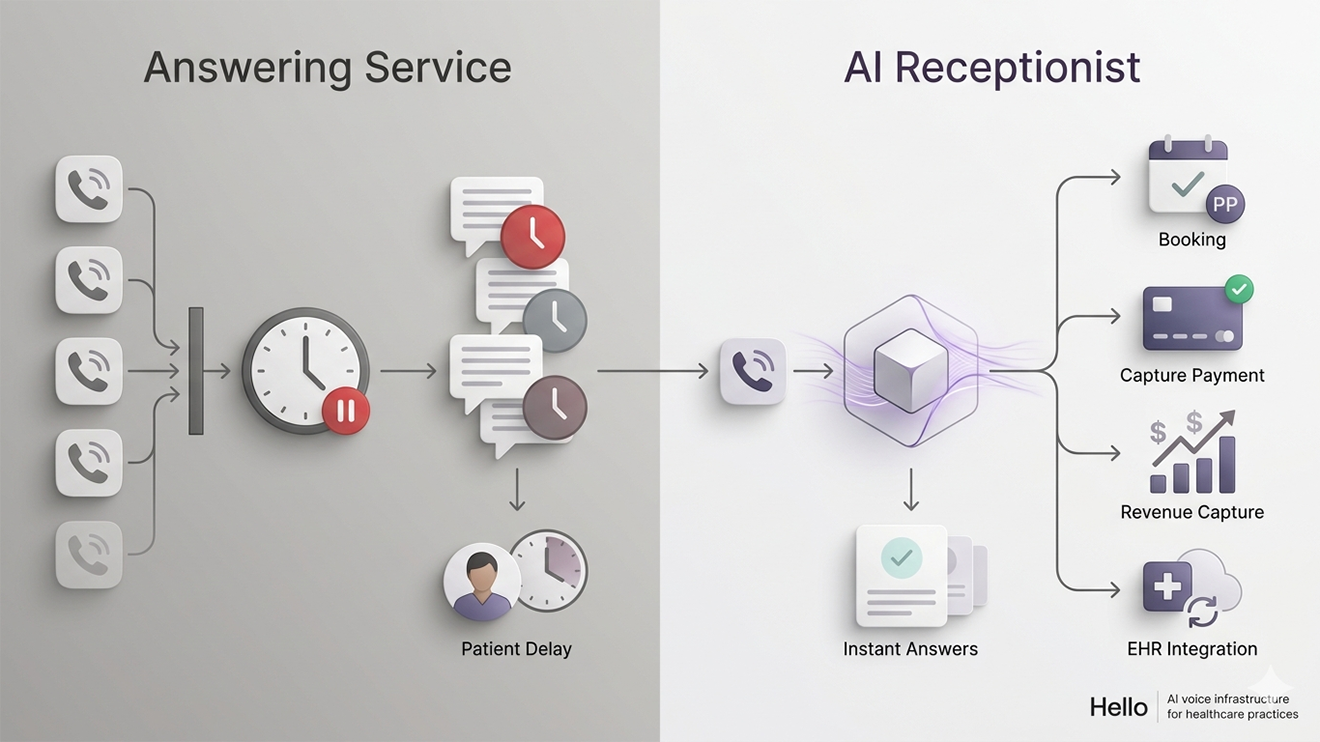
Traditional answering services were built for message relay. The modern dermatology practice needs infrastructure that books, routes, and collects in real time.
The Dermatology Referral Problem No Answering Service Can Solve
Dermatology practices operate differently from most medical specialties. The call mix is unusually complex: a skin cancer screening referral from a PCP has different urgency than a cosmetic Botox inquiry, which has different routing than a Mohs surgery callback. A traditional answering service treats all of these the same: take a message, email it to the office, wait for a human to call back.
By the time your staff processes the message, the referral has already called the next dermatologist on their PCP's list.
A dermatology practice receiving 80 calls per day with a 31% miss rate loses approximately 25 patient opportunities daily. At an average patient lifetime value of $1,200 to $2,400 (depending on procedure mix), the annualized revenue at risk exceeds $84,000 even at conservative conversion assumptions.
This is not a staffing problem. It is a timing problem. Referral patients call once. If no one answers, they do not leave a voicemail and wait. They call the next practice. The traditional answering service model, built around message pads and callback queues, was designed for an era when patients had fewer options and more patience. That era is over.
Why Dermatology Call Routing is Uniquely Difficult
Unlike a general practice where most calls are appointment requests, a dermatology clinic handles at least five distinct call types that require different responses:
- PCP referrals for skin cancer screening are time-sensitive and need to be scheduled within days, not weeks. If the patient hears "we'll call you back," they call the next clinic.
- Mohs surgery follow-up and scheduling requires coordination with the surgeon's specific calendar, not a generic scheduling system.
- Cosmetic consultation inquiries are high-value but price-sensitive. These callers are comparing practices and will book with whoever answers first.
- Prescription refill and clinical questions must be triaged to clinical staff, not taken as a message.
- Rescheduling calls from existing patients are routine but high-volume. Every one that goes to voicemail becomes a no-show, a problem dental practices are solving with deposit collection and 24/7 rescheduling.
A human answering service agent reading from a script cannot differentiate between these. An AI receptionist trained on dermatology workflows can. The question many practice managers ask next is whether dermatology patients actually trust AI receptionists to handle these sensitive interactions.
What a Traditional Answering Service Actually Does (and Does Not Do)
Traditional answering services for dermatologists follow a predictable model: a live operator answers the phone with your practice name, takes a message, and delivers it via email, text, or portal. Some offer appointment scheduling through a shared calendar. Most charge per minute or per call. For a full breakdown of the true cost of a medical answering service, including the hidden costs beyond the invoice, we have published a detailed analysis.
This model has three structural limitations that matter for dermatology:
1. No EHR or PMS Integration
The operator cannot see your schedule, check insurance eligibility, or determine if a new patient referral matches the provider's availability for the specific procedure type. They take a name and a number. Your staff still has to do all the work.
2. No Clinical Triage Capability
When a patient calls about a rapidly changing mole or a post-procedure complication, the answering service agent follows a generic script. They cannot assess urgency, route to the on-call provider, or escalate appropriately. Everything becomes "the office will call you back."
3. Callback Delay Creates the Callback Trap
Every message from the answering service becomes a task on your staff's callback list. By Monday morning, a busy dermatology practice can have 30+ messages waiting. Your team spends the first two hours of the day returning calls instead of checking in the patients who are already in the building. This is the Callback Trap, and traditional answering services make it worse, not better. The problem is structural: answering services lose patients because they can only take messages, not resolve them.
| Capability | Traditional Answering Service | AI Receptionist |
|---|---|---|
| Appointment Booking | Takes a message for staff to book later | Books directly into PMS/EHR in real time |
| Referral Routing | Generic message; no prioritization | Identifies referral type; routes by urgency and provider |
| Insurance Verification | Not available | Checks eligibility before scheduling |
| Deposit Collection | Not available | Collects deposits at booking to reduce no-shows |
| Bilingual Support | Limited; often at extra cost | Real-time Spanish and English |
| Hours of Operation | After-hours only (most plans) | 24/7 including lunch, weekends, holidays |
| EHR Integration | None | Integrates with ModMed, Nextech, DrChrono, AdvancedMD; 37 EHR/PMS connectors and 200 integrations |
| Cost Structure | Per-minute or per-call billing | Flat monthly; no per-call fees |
Notes on this comparison:
- Traditional answering service capabilities vary by vendor. The table reflects the most common feature set across major providers (Ruby, MAP Communications, AnswerConnect).
- AI receptionist capabilities reflect Hello's current platform. Not all AI receptionist vendors offer the same depth of EHR integration or clinical routing.
The Dermatology Patient Experience: AI Receptionist vs. Hold Music
The patient experience argument for AI receptionists is not theoretical. It is the difference between a patient who books and a patient who hangs up.
Scenario: Skin Cancer Screening Referral
Traditional answering service: Patient calls at 12:15 PM during the lunch break. The answering service picks up after three rings. The operator asks for their name, phone number, and reason for calling. The patient says "my doctor referred me for a skin cancer screening." The operator writes it down and says "someone from the office will call you back." The patient hangs up and waits. By 4 PM, no one has called back. The patient calls another dermatologist who answers immediately and books them for Thursday.
AI receptionist: Patient calls at 12:15 PM. The AI answers in under two seconds. It identifies the call as a PCP referral for skin cancer screening, confirms the referring physician, checks provider availability for the appropriate exam type, and books the appointment for Wednesday at 2 PM. It sends a confirmation text with pre-visit instructions and collects a $50 deposit to hold the slot. Total call time: 3 minutes. The patient never calls another practice.
Research from the Harvard Business Review found that the odds of qualifying a lead drop by 400% when the response time moves from 5 minutes to 10 minutes. In dermatology, where referral patients are comparing 2 to 3 practices simultaneously, a same-call booking versus a "we'll call you back" message is the difference between capturing and losing $2,400+ in patient lifetime value.
Scenario: After-Hours Cosmetic Inquiry
Traditional answering service: A prospective patient researching dermal fillers calls at 7:30 PM. The answering service takes a message. The office calls back the next morning at 10:15 AM. The patient is at work and does not answer. Phone tag begins. The patient books elsewhere over the weekend.
AI receptionist: The AI answers at 7:30 PM, provides procedure information, checks the cosmetic coordinator's calendar, and books a consultation for the following week. A confirmation text goes out immediately. The patient is booked before they finish their evening research.
The Economics: Why Practices Are Switching Now
The shift from traditional answering services to AI receptionists is not driven by technology enthusiasm. It is driven by three economic realities:
1. The Cost of Missed Referrals is Permanent
A dermatology referral that goes to a competitor does not come back. Unlike retail, where a customer might return next season, a patient referred for a skin cancer screening will complete that care journey elsewhere. That is not just one lost appointment. It is the entire downstream relationship: follow-up visits, Mohs procedures, annual skin checks, and cosmetic cross-sells that can span 10+ years.
2. Staff Costs Are Rising Faster Than Reimbursements
The average medical receptionist salary has increased 18% since 2020. Dermatology reimbursement rates have not kept pace. Practices that relied on adding front desk headcount to manage call volume are finding the math no longer works. An AI receptionist that handles the equivalent of 2.1 FTEs in call capacity does not require benefits, PTO, or training cycles.
3. The Competitive Window Is Closing
Early-adopting dermatology practices are already capturing the referrals that late adopters are missing. As AI receptionists become the standard in high-volume specialties, practices without them will increasingly find themselves in the "we'll call you back" category while their competitors book patients in real time.
What to Look for in an AI Receptionist for Dermatology
Not all AI receptionist platforms are built for dermatology. Before evaluating vendors, confirm these capabilities:
- The platform must integrate with your specific dermatology PMS/EHR (ModMed EMA, Nextech, DrChrono, AdvancedMD, or your system). If the AI cannot read your schedule and book directly, you still have a callback problem.
- The system should distinguish between a PCP referral for a suspicious lesion and a self-referred cosmetic inquiry. Different urgency, different provider, different scheduling rules.
- Dermatology no-show rates average 15 to 20%. Collecting a deposit at the time of booking, during the call, reduces this dramatically.
- If your patient population includes Spanish speakers, the AI must handle calls fluently in both languages without relying on a third-party translation relay.
- The vendor must sign a Business Associate Agreement (BAA) and maintain enterprise-grade security. Patient information discussed during calls is PHI. Understanding how AI receptionists handle security for sensitive calls is critical before signing any vendor contract.
- The best platforms do not just answer inbound calls. They can run automated outbound campaigns for appointment confirmations, recall reminders, and reactivation of lapsed patients.
- Every call answered in under 5 seconds, 24/7, including lunch breaks and weekends
- Integrates with ModMed, Nextech, DrChrono, AdvancedMD; 37 EHR/PMS connectors and 200 integrations for direct EHR booking
- PCP referrals for skin cancer screenings are flagged and fast-tracked to the appropriate provider
- Secure payment capture at booking reduces no-shows by up to 40%
- Native English and Spanish with no translation delay
- Full BAA, enterprise-grade encryption, 42 CFR Part 2 compliant
FAQ
Can an AI receptionist really handle dermatology-specific scheduling?
Yes. Hello's AI is configured for dermatology workflows, including Mohs surgery coordination, skin cancer screening urgency triage, cosmetic consultation routing, and procedure-specific scheduling rules. It integrates directly with dermatology EHRs like ModMed EMA to book appointments in real time, not take messages.
How does this compare to hiring another receptionist?
A full-time receptionist handles one call at a time during business hours. Hello handles unlimited concurrent calls 24/7, including after hours, lunch breaks, and weekends. The platform delivers the call capacity equivalent of 2.1 FTEs without the overhead of salary, benefits, training, and turnover.
What happens if the AI cannot handle a complex question?
The AI seamlessly transfers to your staff when clinical judgment is required. For questions about treatment plans, medication interactions, or post-procedure complications, the call is routed directly to the appropriate clinical team member. The AI handles the routine volume so your team can focus on cases that genuinely require human expertise.
Is this HIPAA compliant?
Yes. Hello signs a Business Associate Agreement (BAA) with every practice. All patient data is encrypted in transit and at rest. The platform is designed for healthcare from the ground up, not a general-purpose AI adapted for medical use.
How much does an AI receptionist cost compared to a traditional answering service?
Hello is a performance-based platform with done-for-you setup: a full AI Audit of your practice's technology stack, phone system, and workflows before deployment. You pay for completed work and captured outcomes, not per minute. Hello Performance-based serves single and multi-location dermatology practices. Hello Enterprise is custom pricing for established multi-location groups and DSOs. See our pricing page for current rates.
The question for dermatology practices is no longer whether AI receptionists work. It is how long you can afford to keep losing referrals while your competitors book them in real time.