
The bottom line
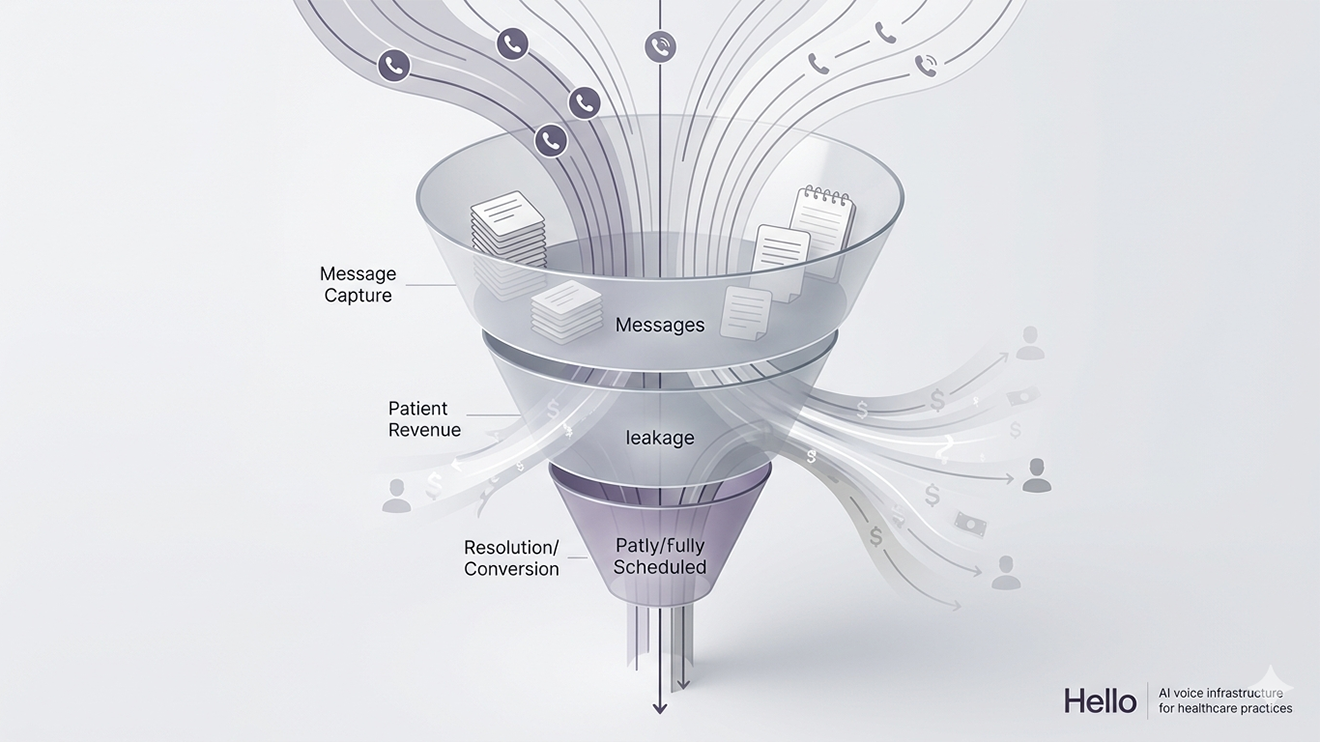
Your medical answering service creates a false sense of coverage. It picks up the phone, records a message, and sends it to your office for follow-up. It feels like your after-hours calls are handled. They are not.
The patient who called at 8 PM to book a cosmetic consultation did not want to leave a message. They wanted an appointment. Your answering service gave them a promise that someone would call back. By 10 AM the next day, when your staff finally returns the call, that patient has already booked with the practice that answered and scheduled on the spot.
This is not a rare scenario. It is the default outcome of every after-hours call your answering service "handles."
The false coverage problem
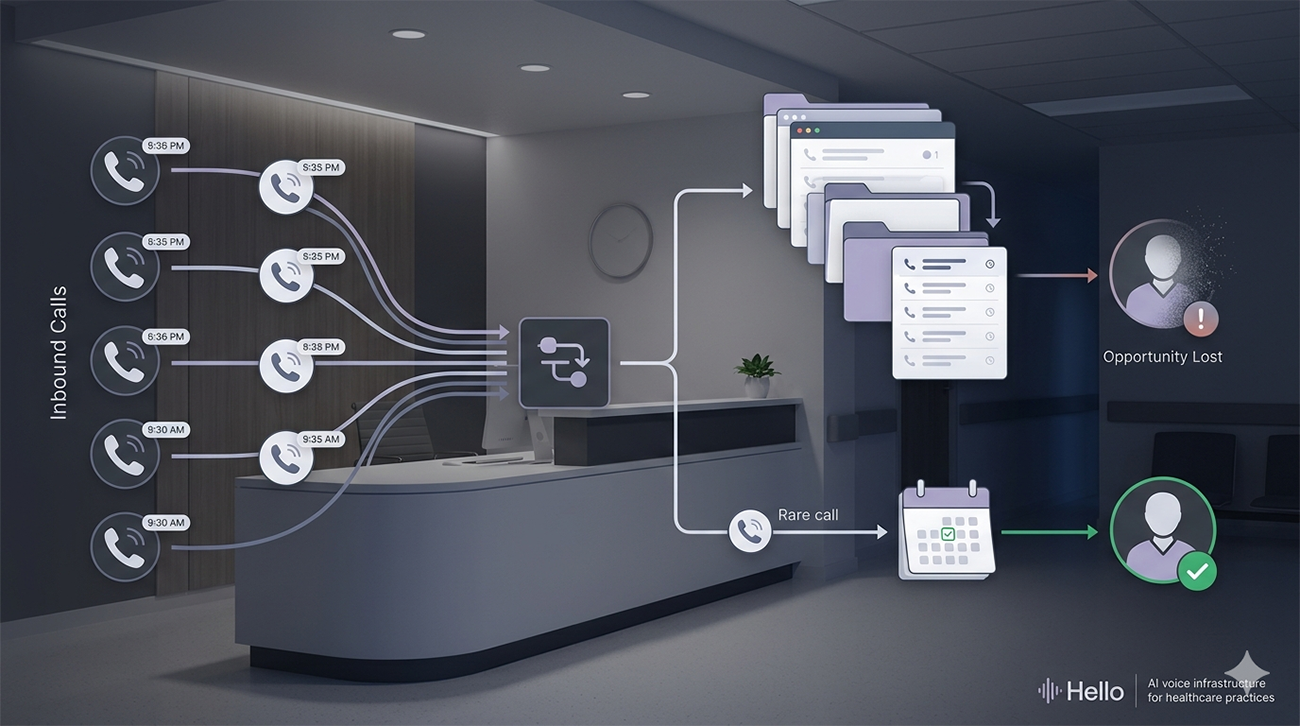
A medical answering service answers your phone. That part works. The problem is what happens next.
When your answering service takes a call, the operator follows a script. They collect the patient's name, phone number, and reason for calling. They flag the message as routine or urgent. Then they relay the message to your office, usually via email, fax, or web portal.
What they cannot do:
- Check your PMS calendar for available slots
- Book an appointment
- Reschedule or cancel an existing appointment
- Collect a deposit or copay
- Verify insurance
- Answer clinical questions beyond what the script covers
- Route calls based on procedure type, urgency, or patient value
Patients expect all of those actions when they call a medical practice. When the answering service cannot do any of them, the patient hangs up with nothing resolved. You feel covered. The patient feels ignored.
The Monday morning compound effect
Weekends make the problem worse. Here is what a typical Monday morning looks like for a high-volume practice using a traditional answering service:
- Staff arrives at 8 AM to 30-50 messages accumulated since Friday evening
- Staff begins returning calls. Most patients do not answer (they are at work, in meetings, driving)
- Voicemails are left. Phone tag begins
- While staff works through the message backlog, the phones are ringing with Monday's new callers
- New callers get busy signals or are sent to voicemail because staff is on callback duty
- By 4 PM, staff has completed maybe 60% of the weekend callbacks and created a new batch of missed calls from today
This is the Callback Trap at its worst. Your answering service did not prevent it. It caused it by turning every after-hours call into a callback task your staff must complete during business hours.
Average time to process one answering service message: 4-6 minutes (read message, pull up chart, dial patient, conversation or voicemail, log outcome).
40 weekend messages × 5 minutes = 3.3 hours of staff time on Monday morning, dedicated exclusively to returning calls that could have been resolved on Friday evening, Saturday, or Sunday.
That is 3.3 hours your front desk is not answering today's incoming calls.
Five call types your answering service cannot handle
Some after-hours calls are routine and can wait until morning. Others are time-sensitive in ways a message-taking service cannot handle.
1. New patient appointment requests
A new patient calls Saturday afternoon because they just got a referral from their primary care physician. They want to book. Your answering service tells them someone will call Monday. By Monday, they have already searched online, found a competitor who answered live (or had online booking), and scheduled there.
New patient calls are the most valuable calls a practice gets. Lifetime value runs $1,500 to $15,000+ depending on specialty. Dermatology clinics replacing their answering services with AI report that most after-hours new patient calls convert to booked appointments when the system can schedule in real time.
2. Post-procedure concerns
A patient who had a procedure on Friday calls Saturday with a question about their recovery. The answering service operator reads a script asking if it is an emergency. The patient says "I don't think so, but..." The operator takes a message. The patient spends the weekend worried. By Monday, some will have gone to an urgent care or ER. That is an unnecessary bill and a bad experience they associate with your practice.
An AI system with clinical routing rules can distinguish between a patient asking about normal post-op swelling and one describing symptoms that require clinical attention. The first gets reassurance and a link to post-care instructions. The second gets routed to the on-call provider.
3. High-value cosmetic consultations
A prospective patient calls at 7 PM interested in a $12,000 cosmetic procedure. They have been researching for weeks and are ready to book a consultation. Your answering service records: "Patient interested in consultation. Please call back." Your staff calls back Tuesday (Monday was packed with callbacks). The patient already booked a consultation with a competitor on Monday morning.
In aesthetic and cosmetic specialties, the window of patient intent is narrow. When a patient is ready to act, the first practice to get them on the schedule wins.
4. Prescription refill requests
A patient calls Friday evening because they ran out of a medication and need a refill called in before the weekend. The answering service takes a message. The patient goes without their medication for two days. That is a satisfaction problem and, depending on the medication, a safety problem.
5. Appointment confirmations and rescheduling
A patient calls Sunday evening to confirm their Monday morning appointment or to reschedule because something came up. The answering service cannot confirm (no calendar access) and cannot reschedule (no scheduling authority). The patient either shows up uncertain or does not show up at all. That is a no-show that could have been a rescheduled visit.
The revenue impact is measurable
The cost of answering service limitations is not abstract. It is countable.
| Call type | Estimated after-hours volume (per month) | Revenue at risk per unresolved call | Monthly exposure |
|---|---|---|---|
| New patient requests | 15-25 | $1,500-$5,000 LTV | $22,500-$125,000 |
| Cosmetic consultations | 5-10 | $5,000-$15,000 | $25,000-$150,000 |
| Rescheduling (prevented no-shows) | 20-40 | $200-$500 | $4,000-$20,000 |
| Urgent callback avoidance | 30-50 | $75-$150 (staff time) | $2,250-$7,500 |
Not every unresolved call means a lost patient. But even if 20% of these calls turn into lost revenue, a mid-volume practice is leaking $10,000 to $60,000 per month from a system that was supposed to provide coverage.
What to do about it
The answer is not "get a better answering service." The limitation is structural. No traditional answering service, regardless of how good the operators are, can access your PMS, book appointments, collect payments, or apply clinical routing rules. These are system-level capabilities, not training issues.
The comparison between AI and traditional answering services comes down to one question: do you want your after-hours calls answered, or do you want them resolved?
An AI answering service resolves calls by:
- Booking appointments with real-time PMS calendar access
- Collecting deposits at the time of booking
- Handling rescheduling and cancellations without staff involvement
- Routing clinical concerns to the appropriate provider based on configurable rules
- Logging every interaction in your EHR with structured data and a full transcript
Your front desk arrives Monday morning to a schedule that was built over the weekend, not a pile of messages to wade through. For a full breakdown of how voice AI handles scheduling, insurance verification, and clinical history collection in a single call, see how AI voice agents improve patient intake.
If you are concerned about security, HIPAA compliance for AI receptionists is a solved problem. Enterprise-grade AI systems sign BAAs, encrypt call data at rest and in transit, and maintain immutable audit logs. Most traditional answering services do not come close to that level of compliance infrastructure.
FAQ
Why do medical answering services lose patients?
Because they can only take messages. They cannot book appointments, check calendars, collect deposits, verify insurance, or route clinical concerns. Patients with high intent to book are told someone will call back. Many do not wait.
What is the difference between a medical answering service and an AI answering service?
A medical answering service records messages and relays them to your office. An AI answering service resolves the call: it checks your calendar, books the appointment, collects a deposit, and logs everything in your EHR. The patient hangs up with a confirmed appointment. For a detailed feature comparison, see AI vs. traditional answering services.
How much does a medical answering service cost compared to AI?
Traditional services charge $0.75 to $1.50 per minute with monthly minimums of $200 to $500. AI answering services use fixed monthly pricing that does not spike during high-volume periods. See Hello's pricing and implementation tiers for specifics.
Your answering service is not broken. It is doing exactly what it was designed to do: take messages. The problem is that taking messages is not enough anymore. Patients expect resolution. The practices that deliver it after hours are picking up the patients your answering service leaves behind.