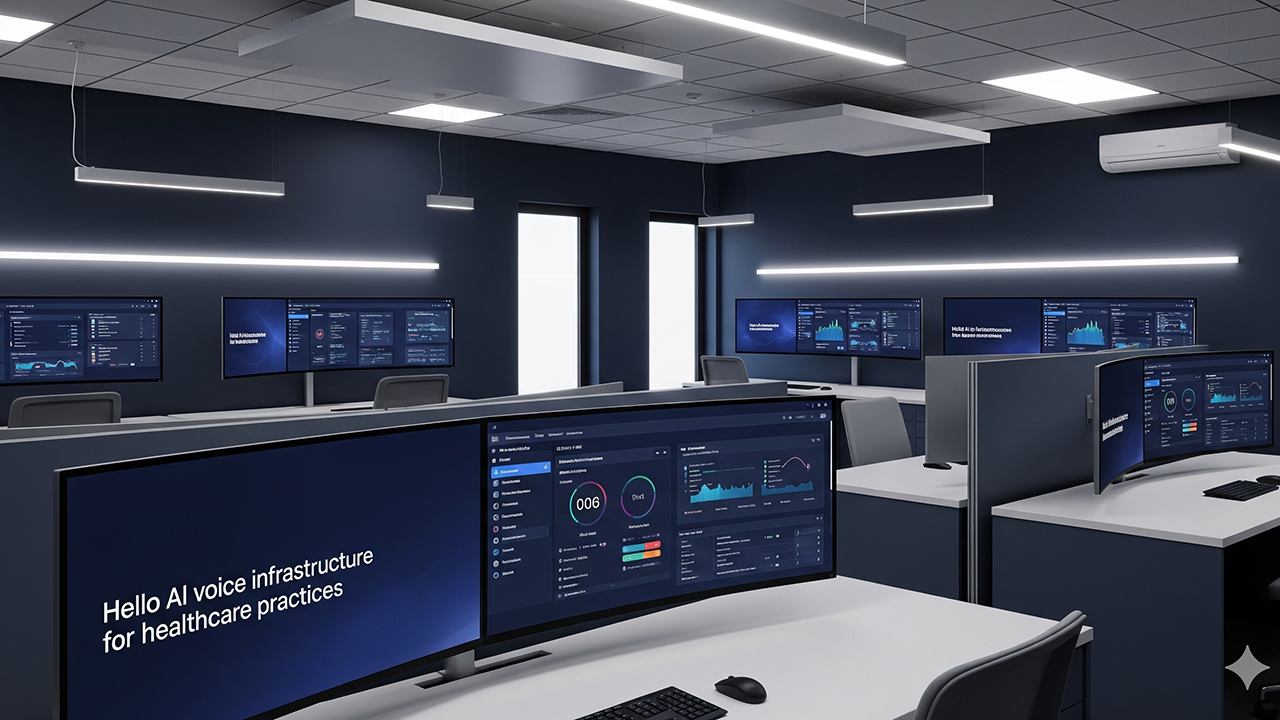

The Scale of Healthcare Data Exposure is Not Slowing Down
In 2024, roughly 275 million healthcare records were breached in the United States. In 2025, that number settled to approximately 57 million individuals affected across more than 640 large-scale breaches reported to the HHS Office for Civil Rights. OCR closed 21 HIPAA investigations with financial penalties in 2025, the second-highest enforcement year on record, collecting over $8.3 million in fines. And in 76% of those enforcement actions, the root cause was the same: a failure to conduct a comprehensive security risk analysis.
These are not abstract statistics. These are practices, health systems, and vendors that believed they had compliance covered. The most common thread is not a sophisticated cyberattack. It is a fundamental gap between what an organization claims about its security posture and what it actually operationalizes day to day.
Now layer AI voice technology on top of that reality. Every inbound patient call processed by an AI receptionist involves the creation, transmission, and potential storage of protected health information. The question is not whether AI receptionists can be secure. The question is whether your specific vendor has built the infrastructure to make security enforceable at the conversation level, not just on a compliance checklist. This is especially critical in specialties like dermatology, where practices are replacing traditional answering services with AI receptionists that handle both medical triage and cosmetic consultation calls. For practices evaluating the switch, a side-by-side comparison of AI and traditional answering services covers the operational differences across scheduling, integration, and compliance.
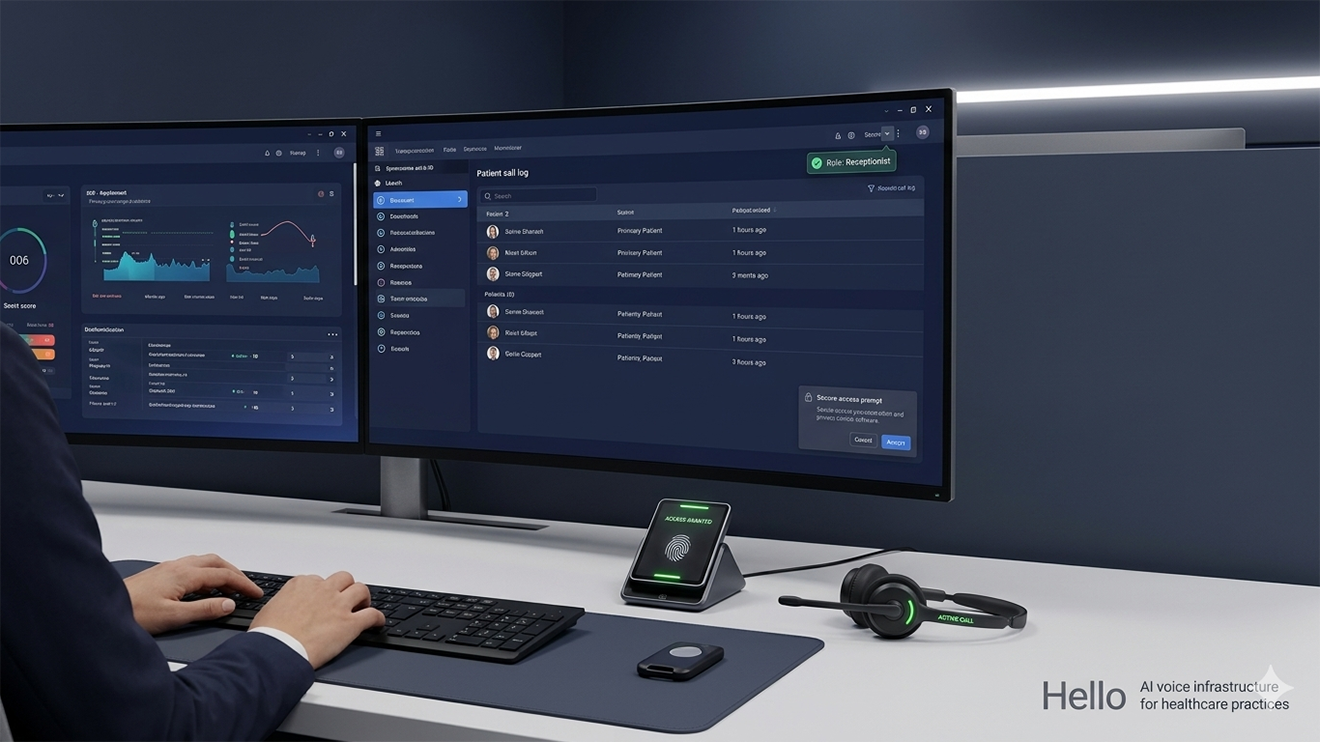
The BAA Misconception: Paper Compliance is Not Operational Compliance
The most common misconception among healthcare practices evaluating AI voice vendors is that having a signed Business Associate Agreement means their patient data is protected. It does not. A BAA is a contractual document. It defines obligations. It does not enforce them.
A BAA says your vendor should encrypt data, maintain audit trails, and report breaches within 60 days. What it does not tell you is whether that vendor actually scans conversations in real time for compliance violations. It does not tell you whether a process exists to detect, investigate, and remediate an incident when one occurs. It does not tell you whether someone is monitoring for drift in the AI agent's behavior over time, or whether the vendor has any mechanism to catch a scenario where the AI inadvertently confirms a patient's substance use disorder status to an unverified caller.
A BAA without operational infrastructure behind it is a liability document, not a protection mechanism. It tells a regulator who to penalize. It does not prevent the violation from occurring.
A signed BAA without operational compliance infrastructure is not a security measure. It is a liability assignment document. It tells OCR who to fine after the breach happens. It does nothing to prevent the breach itself.
Practices deserve better. They deserve vendors that treat compliance as a living, enforced system, not a checkbox on a sales sheet.
What Real Compliance Infrastructure Looks Like Inside an AI Voice System
When we deployed Hello for Dr. Jack Zamora's oculofacial plastic surgery practice in Denver, the security requirements went far beyond signing a BAA and configuring encryption settings. This is a surgical practice handling high-value consultations, sensitive patient communications, and post-operative follow-up calls where the stakes of a compliance failure are both regulatory and clinical.
Building a compliant deployment meant engineering compliance into the conversation layer itself. That required several operational systems working together (see our full security and HIPAA compliance infrastructure for the technical details):
- Every interaction is protected by encryption at rest with post-quantum-ready key management, TLS 1.3 in transit, immutable audit logging, role-based access controls reviewed quarterly, and PII redaction in transcripts and recordings.
- Every conversation is scanned in real time for compliance deviations. When a potential violation is detected, the system raises a case, logs the event, and triggers an investigation workflow to assess scope and impact.
- If a caller mentions or references substance use disorder treatment, the system identifies that signal and enforces the heightened confidentiality protections required under 42 CFR Part 2. No SUD treatment status is confirmed or denied. No counseling notes are referenced. The caller is routed to a care coordinator through a consent-verified pathway.
- Detected violations do not sit in a log file. They initiate a structured process: notification to the provider, impact assessment, and escalation when warranted. The goal is resolution, not just documentation.
- Every deployment undergoes a structured certification process before go-live and a mandatory recertification every 90 days. This includes adversarial scenario testing, CRM regression testing, compliance drift audits, and bilingual routing verification. If a deployment fails recertification, it loses its Enterprise-Ready designation until the issues are resolved.
The result for Dr. Zamora's practice: zero missed calls over six months, zero compliance incidents, and a documented audit trail that demonstrates ongoing compliance, not just initial compliance. Patient trust is a direct outcome of this operational rigor. Research into whether patients trust AI receptionists shows that trust depends on whether the system resolves their needs quickly and securely, not on whether a human or AI is on the other end of the call.
The 42 CFR Part 2 Enforcement Reality
As of February 16, 2026, the 42 CFR Part 2 Final Rule is being actively enforced. OCR has announced its Civil Enforcement Program for Confidentiality of Substance Use Disorder Patient Records, and complaints are now being accepted. The penalties for Part 2 violations are aligned with HIPAA enforcement thresholds, meaning civil monetary penalties, corrective action plans, and settlement agreements are all on the table.
This is a significant shift. Prior to the 2024 amendments, Part 2 violations carried only criminal penalties: $500 for a first offense and $5,000 for subsequent offenses. Under the new framework, the full weight of the HIPAA Enforcement Rule applies. OCR can conduct compliance reviews, investigate complaints, and impose penalties that scale with the severity and duration of the violation.
For any healthcare practice that touches behavioral health, addiction services, or SUD-adjacent care, this changes the risk calculus on vendor selection. If your AI voice system cannot distinguish between a standard scheduling call and a call that triggers Part 2 protections, you have a compliance gap that is now enforceable. Meanwhile, practices without any AI infrastructure face a different but equally costly problem: the callback trap, where staff burn hours returning missed calls instead of serving patients who are already in the building. Traditional answering services compound this issue because they cannot resolve calls, only record them, creating more callback work rather than less.
Hello built Part 2 detection into the voice agent prompt architecture. When a caller's inquiry involves substance use disorder treatment, the system activates a separate consent verification flow before proceeding. If no valid TPO consent is on file, the agent collects only a name and callback number, routes to the care coordinator, and captures zero SUD-related data in the transcript. Every step in this flow is implemented, testable, and auditable.
What to Ask Any AI Voice Vendor Before You Sign
Whether you are evaluating Hello, another HIPAA-compliant AI voice platform, or a legacy service, these are the questions that separate vendors with real compliance infrastructure from those selling paper compliance:
- Does the BAA cover the full scope of data the system generates? That includes voice transmission, AI-generated transcripts, call recordings, voicemail processing, and metadata. A BAA that covers only one layer leaves the rest exposed.
- Can the vendor show you an audit log from a test call? Immutable, timestamped audit trails should be available for every interaction, not generated on request after the fact.
- How does the system handle a caller who mentions substance use treatment? If the answer is "the same as any other call," that is a Part 2 compliance gap.
- What happens when the AI makes a compliance error? There should be a detection mechanism, a case management workflow, and an escalation process. If the answer is "we review transcripts periodically," that is reactive, not protective.
- How does the vendor test for compliance drift over time? AI systems degrade. Prompts drift. CRM integrations change. Without structured, recurring certification, a system that was compliant at deployment may not be compliant three months later.
Security is Infrastructure, Not a Feature
The AI receptionist market is growing rapidly, and the majority of vendors entering the space are building for speed, not for compliance. They ship fast, sign BAAs, and move on. The operational layer between that BAA and the actual protection of patient data does not exist in most of these products.
At Hello, compliance infrastructure is not an add-on tier. It is the architecture. Every call is encrypted end to end. Every interaction is logged immutably. Every deployment is certified before it goes live and recertified every quarter. Violation scanning runs on every conversation. Part 2 protections are implemented at the prompt level, not bolted on after the fact.
We built this because healthcare practices deserve a vendor that treats their patients' data with the same rigor they apply to clinical care. If your current phone system or AI vendor cannot answer the questions above with specifics, documented evidence, and a live demonstration, it is worth asking what exactly that BAA is protecting.
Hello secures every deployment with the same rigor described above: end-to-end encryption, quarterly recertification, real-time violation scanning, and Part 2 consent enforcement at the prompt level.
FAQ
What encryption standard should an AI receptionist use for healthcare calls?
strong encryption in transit and at rest, with post-quantum-ready key management for data at rest and TLS 1.2+ for data in transit. These are the minimum standards recognized by the HHS Office for Civil Rights. Any vendor offering weaker encryption (AES-128 or TLS 1.0/1.1) does not meet current OCR guidance for protected health information.
Is a BAA enough to make an AI receptionist HIPAA compliant?
No. A Business Associate Agreement is a legal document, not a technical control. A BAA without operational safeguards (encryption, access controls, audit logging, breach detection) is paper compliance. OCR enforcement actions consistently target organizations that signed BAAs but failed to implement the technical and administrative controls those agreements reference.
How does 42 CFR Part 2 affect AI voice systems in behavioral health?
Part 2 requires additional consent controls beyond standard HIPAA for substance use disorder records. An AI voice system must be able to detect when a call involves SUD-related scheduling or intake, enforce consent verification before processing, and segment those records with stricter access controls. The 2026 rule changes align Part 2 penalties with HIPAA, making violations significantly more expensive.
Can an AI receptionist integrate with EHR systems securely?
Yes, but the integration method matters. Hello uses API-level integration with EHRs like Nextech, ModMed, and DrChrono through authenticated, encrypted connections with role-based access controls. Each integration point logs every read and write operation to an immutable audit trail. Vendors that rely on screen scraping or unencrypted data exports introduce compliance gaps that a BAA cannot cover.
Schedule a 20-minute walkthrough. We will show you real-time violation scanning, Part 2 consent verification, and a live audit log from a test call.