
The bottom line
No-shows cost the average dental practice $150,000 or more per year. That number is not a typo. It is the cumulative cost of empty chairs, wasted prep time, and revenue that walked out the door without calling to cancel.
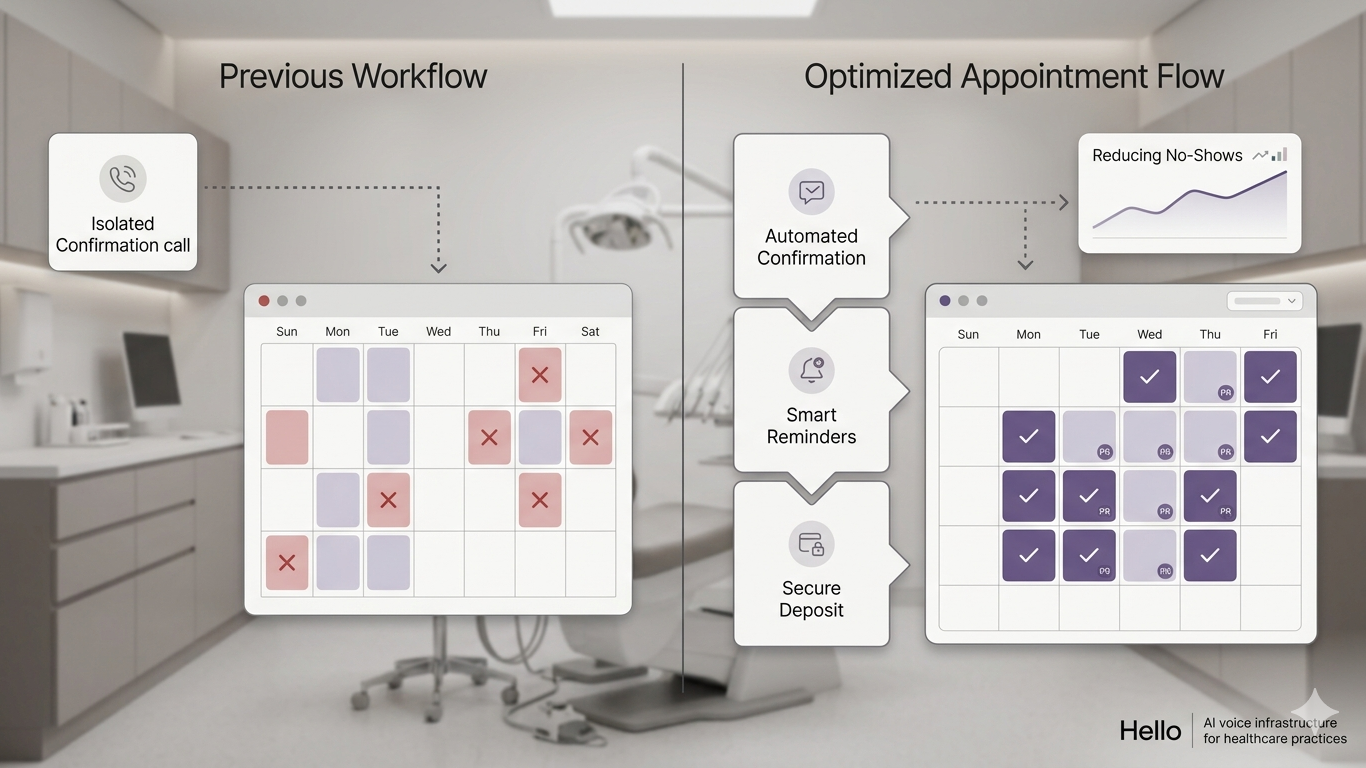
The dental practices cutting their no-show rates by 40% or more are not doing anything exotic. They are doing two things: collecting a deposit when the appointment is booked, and making it easy for patients to reschedule instead of disappearing. The ones doing this at scale are using AI to handle both, 24 hours a day, without adding headcount.
What dental no-shows actually cost
The average dental practice sees a no-show rate between 15% and 20%. Some urban practices report rates above 30%. The math is not complicated, but most practice owners have never calculated it for their own schedules.
A general dentistry practice scheduling 30 appointments per day at an average value of $275 per visit:
30 appointments × 18% no-show rate = 5.4 empty slots per day
5.4 slots × $275 = $1,485 lost per day
$1,485 × 220 working days = $326,700 per year in unfilled capacity
Not all of that is recoverable. Some patients reschedule, some were low-value. But even recovering half changes the financial picture of the practice.
Beyond the direct revenue loss, no-shows create cascading operational problems. Your hygienists have empty chairs. Your front desk scrambles to fill gaps on short notice. Your schedule becomes unreliable, which makes staffing decisions harder. And the patients who do show up sometimes wait longer because your team reshuffled the day around cancellations.
Approaches that underperform
Most dental practices have tried to address no-shows. None of the standard plays work as well as you'd expect.
Manual reminder calls
Your front desk calls patients one or two days before their appointment. This works if the patient answers. The problem is that contact rates for outbound calls from a dental office are low, especially during business hours when both your staff and the patient are busy. Your team leaves voicemails that may or may not be heard, and the staff time spent dialing eats into their capacity for incoming calls. This creates a version of the Callback Trap, where outbound follow-up work prevents your team from handling inbound demand.
Text reminders
Automated text reminders are better than phone calls. They require no staff time and most patients see them. But a text sent 24 hours before the appointment is often too late to change behavior. The patient who was going to no-show has already mentally checked out by then. And a one-way text reminder does not let the patient reschedule on the spot. They have to call back, navigate your phone system, and hope someone is available. Many do not bother.
Overbooking
Some practices overbook by 10-15% to compensate for expected no-shows. This works on average days. On the days when everyone shows up, it creates chaos: long wait times, rushed appointments, stressed staff, and patients who feel like they are on an assembly line. It also makes the scheduling data unreliable. You cannot measure your true no-show rate when the schedule is padded.
Why dental patients actually no-show
The usual explanation is "patients forget." That is true for some percentage, but it is not the full story. In most practices, no-shows fall into a few categories:
- They forgot (addressable with reminders, but reminders alone do not solve the problem)
- They wanted to reschedule but could not reach the office (hold times, voicemail, business hours only)
- The appointment felt optional (routine cleaning with no financial commitment)
- Something came up and canceling felt like too much effort (calling, waiting on hold, explaining)
- Anxiety about the visit itself (dental phobia is real and affects 36% of the population according to published surveys)
The first four categories come down to friction. When rescheduling is easy, patients reschedule instead of disappearing. When they have money on the line at the time of booking, they show up or call to move the appointment. Remove the friction, and the no-show rate drops.
What actually reduces dental no-shows
1. Collect a deposit at booking
This is the single biggest lever. When a patient puts $50 or $100 down at the time they book, their commitment to the appointment changes. They have skin in the game. If something comes up, they call to reschedule because they want to preserve that deposit. Without the deposit, they simply do not show up.
The hard part has always been logistics. Collecting deposits by phone requires your front desk to process a payment during the call, which adds time and complexity. If a patient books after hours through voicemail, there is no mechanism to collect anything. Traditional answering services cannot collect deposits because they have no payment processing capability and no integration with your PMS (Dentrix, Eaglesoft, Open Dental, or Curve Dental).
An AI answering service collects the deposit during the booking call, 24/7, and records the transaction in your practice management system automatically. The patient pays while they are still on the phone and motivated to book, not days later when an email asks them to prepay.
2. Remove friction from rescheduling
If your rescheduling process requires a patient to call during business hours, wait on hold, and speak with a staff member, many patients will skip it entirely. They will just not show up.
The fix is to let patients reschedule through the same channel they used to book: a phone call. But that call needs to be answered immediately, at any hour, and the system needs to see your calendar to offer real alternatives. An AI receptionist for dental practices handles rescheduling in the same call flow as booking, with no hold time and no business-hours restriction.
3. Fill cancellations from the wait list automatically
When a patient does cancel or reschedule, you have a narrow window to fill that slot. The manual approach (front desk scrolls through a wait list, makes calls, leaves voicemails, waits for callbacks) rarely fills the gap in time.
An AI system can contact wait-listed patients immediately when a slot opens, confirm their availability, and book them during the same call. The gap between cancellation and fill shrinks from hours to minutes.
4. Confirm at multiple touchpoints
A single reminder is easy to miss. Practices seeing the best no-show rates use a sequence: confirmation at booking, a reminder 48 hours before, and a same-day reminder. Each touchpoint should include a one-tap option to reschedule. The reminder itself becomes an off-ramp that turns a potential no-show into a rescheduled visit.
How AI makes this work without adding staff
You can do each of these four things manually. But doing all four at scale, for every appointment, every day, requires capacity your front desk does not have. AI fills that gap.
An AI receptionist configured for a dental practice:
- Books appointments and collects deposits in the same call, including after hours
- Handles rescheduling requests 24/7 with real-time calendar access
- Contacts wait-listed patients automatically when cancellations occur
- Sends multi-touchpoint confirmations without consuming staff time
Your front desk team spends their time on the patients in the chair and on complex cases that require human judgment. The AI handles the repetitive scheduling, collection, and reminder work that creates most of the no-show problem in the first place.
We wrote separately about HIPAA compliance and data protection for AI receptionists in healthcare settings.
What you can do this week
You do not need to overhaul your entire operation to start reducing no-shows. Pick any of these and you can have it running within a week:
- Calculate your actual no-show cost. Pull your no-show rate from your PMS (Dentrix, Eaglesoft, or Open Dental all have this report) for the last 90 days. Multiply by average appointment value and working days. The number will be larger than you expect.
- Implement deposits for high-value procedures. Start with crowns, implants, and cosmetic procedures. These have the highest per-slot cost when a patient does not show.
- Enable 24/7 rescheduling. If patients can only reschedule during your business hours, you are losing rescheduling opportunities every evening and weekend. An AI phone system or online portal fills this gap.
- Track no-show rate by appointment type. Cleanings, new patient exams, and high-value procedures have different no-show profiles. Segment your data so you can target interventions where they matter most.
If your practice reduces no-shows from 18% to 10% (a 44% reduction):
That is 2.4 fewer empty slots per day × $275 = $660 recovered per day.
Over 220 working days: $145,200 in annual recovered revenue.
Even a modest deposit requirement paired with frictionless rescheduling can produce this result. See implementation tiers and pricing to understand what the setup involves.
FAQ
What is the average dental no-show rate?
Between 15% and 20% for most practices. Urban practices and those serving Medicaid populations often see rates above 25%. High-value procedures like implants and crowns tend to have lower no-show rates when deposits are collected at booking.
Does collecting deposits actually reduce no-shows?
Yes. Financial commitment at the time of booking materially changes patient behavior. Patients who have money on the line are more likely to show up or call to reschedule. Practices that pair deposits with frictionless rescheduling (available 24/7 by phone) see the largest reductions.
How can dental practices fill last-minute cancellations?
AI-powered scheduling systems contact wait-listed patients automatically when a cancellation opens a slot. Because the AI reaches out immediately and can book the replacement appointment during the same call, the gap between cancellation and fill shrinks from hours to minutes.
No-shows are not an unsolvable problem. They are a friction problem. Remove the friction from rescheduling, add a financial commitment at booking, and automate the fill process. The practices doing all three are seeing 40%+ reductions without hiring anyone.