

How AI Voice Agents Improve Patient Intake
AI voice agents improve patient intake by automating scheduling, insurance verification, and clinical history collection directly over the phone without human intervention. By integrating with EHR platforms like Nextech and Athenahealth via HL7/FHIR, these agents reduce call abandonment and eliminate manual data entry for front desk staff.
This guide is for healthcare practices handling 500+ monthly calls where front desk staff are stretched between phone duty and in-office patient care. It covers AI voice infrastructure for intake automation, EHR integration, and after-hours coverage. It does not cover text-based messaging or clinical decision support tools.
An AI voice agent is a software-based infrastructure layer that uses Natural Language Processing (NLP) and Large Language Models (LLMs) to conduct real-time phone conversations with patients, handling scheduling, intake, and call routing without keypad menus or hold queues.
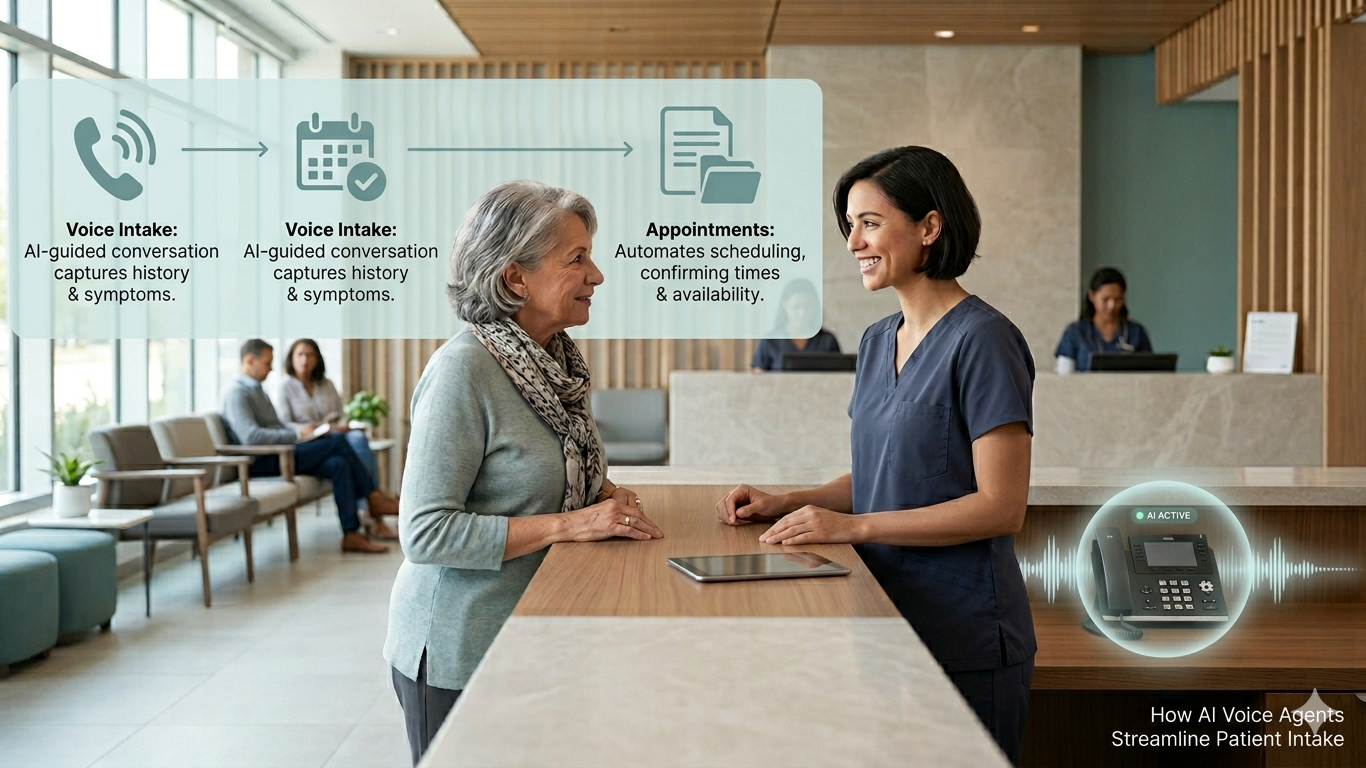
What is an AI voice agent in healthcare?
An AI voice agent is software infrastructure that uses NLP and LLMs to conduct verbal conversations with patients over the phone. Unlike traditional IVR (Interactive Voice Response) systems that rely on keypad inputs ("Press 1 for Scheduling"), an AI voice agent understands intent, handles interruptions, and responds in under 200 milliseconds to maintain natural conversational flow.
The distinction matters for practices evaluating their options. IVR systems route calls through menus. AI voice agents handle the call from start to finish: they verify insurance, check the scheduler for open slots, and book appointments in your EHR while the patient is on the line.
The word "agent" is intentional. Where an IVR system is a gate that redirects traffic, an AI voice agent is infrastructure that takes action. It collects intake data, confirms eligibility, and writes the record back to the patient chart. The patient hangs up with an appointment booked, not a callback pending.
Why AI voice infrastructure matters for patient access
The core problem in medical practice management is the callback trap: when a patient calls to schedule and reaches voicemail, the risk of patient leakage increases with every second of hold time. One captured after-hours consultation can pay for months of AI voice infrastructure.
For a plastic surgery practice where a single consultation is worth $15,000, three missed calls per day add up to $45,000 in weekly revenue exposure. That math gets worse during peak hours when the front desk is already at capacity. For a full accounting of how those costs compound, including per-minute charges and staff callback labor, see the true cost of a medical answering service in 2026.
AI voice infrastructure eliminates this bottleneck in four ways:
- Elastic capacity. AI agents handle concurrent calls without limitation. A physical front desk is limited by the number of phone lines and staff members.
- Data integrity. Patient information is captured digitally and written directly into the chart via HL7/FHIR, eliminating misspelled names and incorrect insurance IDs that staff must later correct.
- After-hours coverage. Practices capture the 30% of new patient inquiries that happen outside of 9-to-5 hours. According to Hello's beta measurement framework, AI voice agents book 85%+ of after-hours inquiries without human involvement.
- Deposit collection at booking. Securing a deposit during the intake call reduces no-show rates. The AI collects payment before the patient hangs up, not after a callback attempt the next morning.
For practices still using a traditional answering service, the gap between "answering" and "acting" is where patients go. See why your medical answering service is losing you patients for a breakdown of that gap.
How AI voice agents work with your EHR
To be effective, an AI voice agent cannot operate in isolation. It needs real-time access to your practice's scheduling data and patient records. Hello connects to your existing EHR stack via HL7/FHIR APIs and vendor-specific integrations.
| Capability | Legacy IVR Systems | Hello Voice Infrastructure |
|---|---|---|
| Input Method | Keypad / DTMF ("Press 1") | Natural Language Speech |
| Response Latency | High (laggy menu transitions) | Sub-200ms (human-like pacing) |
| EHR Integration | None (requires manual notes) | Bi-directional (Epic, Athena, Nextech) |
| Patient Context | Resets every call | Maintains patient history and context |
| HIPAA Compliance | Variable / standard phone line | Encrypted, SOC 2 Type II, BAA included |
| Revenue Capture | None | Deposit collection at booking |
The integration works with the phone systems practices already use. RingCentral, 8x8, Vonage, and analog POTS lines are all supported. Hello sits between the phone network and your EHR as a high-speed intelligence layer.
For practices concerned about double-contact conflicts with existing recall tools like RevenueWell or Solutionreach, Hello's confirmation workflows coordinate with these systems rather than duplicate them. For a full comparison of how AI and traditional answering models differ across scheduling, compliance, and cost, see AI answering service vs. traditional medical answering service.
How Hello connects to your clinical workflow
Integrating Hello into a medical practice does not require replacing your existing phone system. The infrastructure sits between the Public Switched Telephone Network (PSTN) and your EHR.
SIP trunking and routing
Your existing carrier (RingCentral, Avaya, or Vonage) is configured to route specific traffic (appointment lines, billing inquiries) to the Hello SIP endpoint. No hardware changes are needed.
Real-time data bridge
Using HL7 FHIR or proprietary REST APIs, the AI agent queries your scheduler (Nextech, eClinicalWorks, or PatientNow) to identify open slots or pull patient records. For dental practices running Dentrix (~40% market share) or Eaglesoft (~20%), the same data bridge applies through vendor-specific connectors.
Write-back automation
Once a call concludes, the agent generates a structured data payload and a human-readable transcript, filed automatically under the patient's chart in your EHR. Bi-directional sync latency is under 5 minutes.
Unlike basic voice bots, Hello's infrastructure supports sub-200ms response latency with multi-provider failover. When a patient pauses to ask a question, the AI responds without the 3-second delay typical of standard LLM wrappers.
Use the Hello ROI calculator to model how quickly intake automation pays for itself against your call volume and average patient value.
Security and compliance for voice-based patient intake
In healthcare, data security is the pass/fail gate. A HIPAA infrastructure is not optional. For a deeper look at what separates real compliance infrastructure from paper compliance, see how secure is an AI receptionist for sensitive business calls.
Data protection standards
- End-to-end encryption. All voice streams are encrypted in transit using TLS 1.2+ and at rest using industry-standard encryption with post-quantum-ready key management.
- Automatic PII redaction. A sanitization layer identifies and masks PHI (Social Security Numbers, credit card details) from call transcripts before storage.
- SOC 2 Type II audited. Annual third-party audits verify the operational effectiveness of security controls.
The Business Associate Agreement (BAA)
Hello provides a standard BAA for all clinical partners at every tier, signed before go-live. This legal framework ensures Hello assumes responsibility for protecting PHI in accordance with federal law.
| Security Category | Hello Standard | Why It Matters |
|---|---|---|
| Identity Management | Multi-Factor Authentication (MFA) | Prevents unauthorized dashboard access |
| Audit Logs | Immutable 90-day logs | Simplifies compliance during internal audits |
| Voice Privacy | Voice biometric masking | Patient voices are not used for AI training |
FAQ
Can an AI voice agent accurately verify insurance?
Yes. The agent prompts the patient for their Member ID and Group Number, then cross-references the data with a clearinghouse or your EHR's eligibility tool in real-time. If a mismatch occurs, the agent asks the patient to clarify or sends a secure SMS link for them to upload a photo of their card.
Is AI voice intake HIPAA?
Hello uses a privacy-first architecture: end-to-end encryption for all voice data (TLS 1.2+ in transit, strong encryption at rest with post-quantum-ready key management), automatic PII redaction from transcripts before storage, and a Business Associate Agreement (BAA) signed before go-live at every tier. The infrastructure undergoes annual SOC 2 Type II audits.
How does it handle complex clinical questions?
It does not provide clinical advice. The infrastructure handles intake and administrative routing only. If a patient asks a clinical question ("Is this rash infected?"), guardrails detect clinical intent and immediately warm-transfer the call to a licensed triage nurse or the on-call provider. The AI never provides medical advice.
What happens to my front desk staff?
They stop spending hours on confirmation calls and phone tag. Hello automates routine calls (confirmations, directions, hours, insurance verification) so staff can focus on surgical patients, VIP relationships, and complex cases that require a human. The role shifts from phone operator to patient experience coordinator. No retraining is required on their end.
Which EHR systems does Hello integrate with?
Hello has production-ready integrations with Nextech (~35% of aesthetic/surgical practices) and PatientNow (~20% of med spas). ModMed, DrChrono, and Kareo/Tebra integrations are available. For dental practices, Dentrix (~40% market share), Eaglesoft (~20%), Curve Dental, and Open Dental are on the integration roadmap. Bi-directional sync latency is under 5 minutes.
What this means for your practice
AI voice infrastructure handles the calls your front desk cannot get to. Your staff handles the patients your AI should not. The callback trap breaks. After-hours revenue stops walking to competitors. For practices already handling 500+ monthly calls and growing, the question is how quickly voice AI can be connected to your EHR.
Book a voice demo to hear Hello handle a live patient call against your scheduling data.