
The bottom line
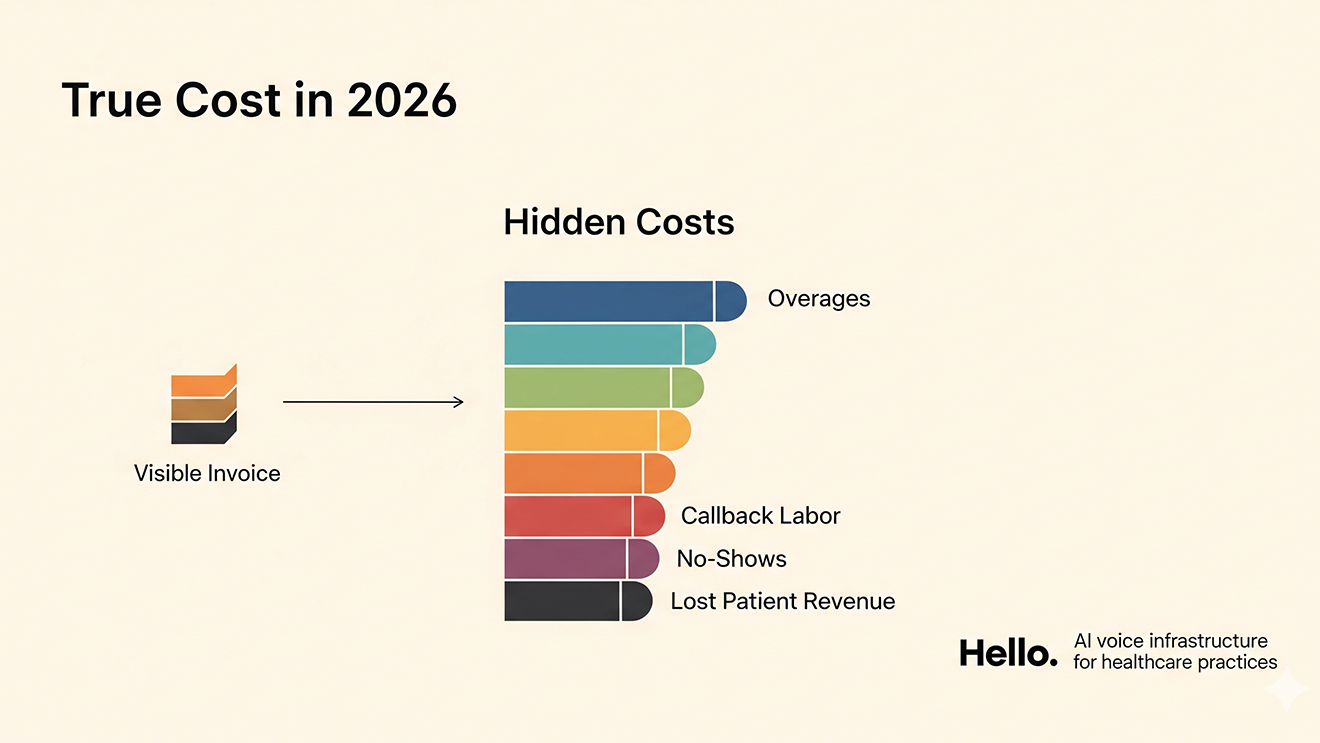
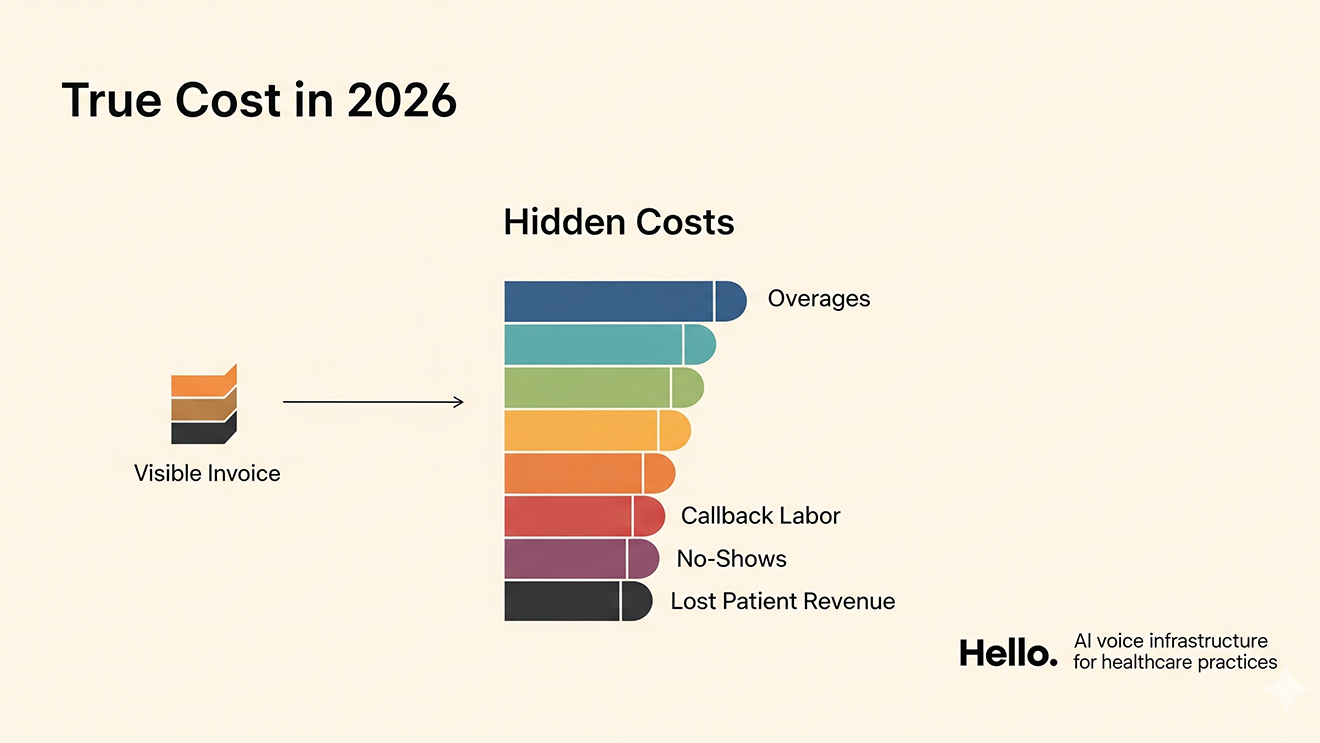
The sticker price of a medical answering service is $200 to $500 per month. The true cost is 10 to 50 times higher.
That gap exists because the invoice only shows operator time. It does not show the 3+ hours of staff labor your front desk spends processing messages every Monday morning. It does not show the patients who called after hours, left a message, and booked with a competitor before your team returned the call. And it does not show the per-minute overage charges that spike during your busiest periods, which is exactly when you assumed your coverage was working hardest for you.
What follows is the full breakdown: invoice line items, the staff labor buried in your payroll, and the lost revenue sitting in your PMS as appointments that never got booked.
What your answering service invoice actually shows
Medical answering service pricing follows a tiered model. You pay a monthly base rate that includes a set number of operator minutes. Usage above that threshold is billed per minute. Most practices exceed their included minutes, especially during high-volume periods.
| Cost component | Typical range | Notes |
|---|---|---|
| Monthly base rate | $200-$500 | Includes 100-300 operator minutes depending on plan |
| Per-minute overage | $0.75-$1.50/min | Charged for every minute above plan inclusion |
| After-hours premium | $0.10-$0.50/min surcharge | Applied to calls between 6 PM and 8 AM, weekends, holidays |
| Holiday surcharge | 1.5x-2x base rate | New Year's, Thanksgiving, Christmas, and other federal holidays |
| Setup fee | $50-$200 | One-time account configuration and script programming |
| Early termination fee | $100-$500 | Charged if canceling before contract term ends |
For a mid-volume practice (300-500 calls per month with after-hours coverage), the typical monthly bill lands between $600 and $1,500 once overage and surcharges are applied. That is the number you see on the invoice. It is not the number that matters.
The costs that do not appear on any invoice
1. Staff time processing messages
Every message your answering service generates creates a task for your front desk. Each message requires your staff to: read the message, pull up the patient's chart (or create a new record), dial the patient, have a conversation (or leave a voicemail and wait for a return call), log the outcome, and move on to the next message.
Average processing time per message: 4 to 6 minutes. For a practice receiving 30 after-hours messages per week, that is 2 to 3 hours of front desk labor, every week, dedicated to resolving calls that the answering service "handled." This is the Callback Trap in financial terms.
30 messages/week × 5 minutes each = 2.5 hours/week
2.5 hours × $22/hour (average front desk wage + benefits) = $55/week
$55 × 52 weeks = $2,860/year in callback labor
For high-volume practices with 80+ after-hours messages per week, this number approaches $7,500/year.
2. Phone tag overhead
The 4-6 minute estimate above assumes the patient answers. In practice, the first callback attempt reaches the patient less than half the time. Most practices report 2-3 callback attempts per message before a conversation happens. Each failed attempt takes 2-3 minutes (dial, wait, voicemail, log). The phone tag cycle doubles the effective labor cost of every unresolved message.
3. Lost patients from unresolved calls
This is the largest cost and the hardest to see on a spreadsheet. When a new patient calls after hours and your answering service takes a message, that patient is not waiting patiently for a callback. They are searching for another practice that can schedule them now.
How much revenue does each lost new patient represent? It depends on specialty. In general dentistry, a single patient is worth $1,500 to $3,000 over their lifetime. In cosmetic derm, that number jumps to $5,000 to $15,000. For aesthetic procedures, it can reach $10,000 to $50,000.
Run the conservative version of this math. If your answering service loses you 5 new patients per month because it could not book them on the call, and average new patient LTV is $2,500, that is $12,500 per month in lost lifetime revenue. $150,000 per year.
4. No-shows from unconfirmed appointments
Patients who call to confirm or reschedule appointments on evenings and weekends reach your answering service. The answering service cannot confirm (it has no calendar access) and cannot reschedule (no scheduling authority). The result: the patient either shows up uncertain or does not show at all.
For dental practices, no-shows cost $150,000+ per year on average. A portion of those no-shows are patients who tried to reach the practice and could not get their question answered by the service that picked up the phone.
5. Opportunity cost of staff on callback duty
Every hour your front desk spends processing answering service messages is an hour they are not spending on the patient in the chair or the new patient inquiry that just called in. This opportunity cost never shows up on a report, but it drags down your practice's daily output.
Total cost of ownership: the real number
Let us put all the cost layers together for a mid-volume practice (400 calls/month, 80 after-hours messages/month).
| Cost layer | Monthly | Annual |
|---|---|---|
| Answering service invoice (base + overage) | $800-$1,200 | $9,600-$14,400 |
| Staff callback labor | $400-$625 | $4,800-$7,500 |
| Phone tag overhead (2x multiplier) | $200-$315 | $2,400-$3,780 |
| Lost new patients (5-10/month) | $12,500-$25,000 | $150,000-$300,000 |
| No-show revenue loss (attributable portion) | $1,000-$3,000 | $12,000-$36,000 |
| Total cost of ownership | $14,900-$30,140 | $178,800-$361,680 |
The invoice says $800 to $1,200 per month. The total cost of ownership, including the labor and revenue consequences of the message-only model, is $14,900 to $30,140 per month. That is a 12x to 25x multiplier over the sticker price.
Methodology notes:
- Answering service rates based on published pricing from Ruby, AnswerConnect, MAP Communications, and PatientCalls (2025-2026).
- Front desk labor cost calculated at $22/hour (national median for medical receptionists, including benefits). Source: Bureau of Labor Statistics, Occupational Employment and Wage Statistics.
- Patient lifetime values based on specialty averages. Actual LTV varies by practice, procedure mix, and payer mix. Use your own PMS data for practice-specific calculations.
- Lost patient estimates assume that 20-40% of unresolved after-hours new patient calls result in the patient booking elsewhere. Calibrate with your own callback conversion rates.
The per-minute pricing trap
Per-minute pricing creates a perverse incentive structure. Your answering service costs you the most during the periods when you need it the most.
Monday mornings after a long weekend mean high call volume and high per-minute charges. The same thing happens during flu season and post-holiday weeks. Your answering service bill spikes at exactly the moments when your staff has the least spare capacity to deal with it.
An AI answering service uses fixed monthly pricing. Whether your practice receives 200 calls or 2,000 calls in a month, the cost does not change. No per-minute charges, overage fees, or holiday surcharges. Predictable costs that do not punish you for being busy.
What an AI answering service costs instead
Most AI answering services in healthcare use implementation-based pricing. You pay a one-time setup fee for configuration, PMS integration, and voice customization, then a fixed monthly subscription.
Monthly pricing depends on the vendor, but for a mid-volume single-location practice, expect $500 to $1,500 per month with no per-minute charges. The implementation fee pays for the upfront work: your scheduling rules get programmed in, the system connects to your PMS, and your team runs test calls before going live.
But the real comparison starts when you subtract what AI eliminates:
- No callback labor (calls are resolved, not messaged)
- No phone tag overhead (appointments booked during the call)
- Reduced patient loss (after-hours calls result in booked appointments, not messages)
- Reduced no-shows (deposits collected at booking, rescheduling available 24/7)
For practices handling 200+ calls per month, the economics favor AI. For practices handling 500+, the case is not close. See Hello's implementation tiers for specific pricing at each volume level.
When a traditional answering service is actually cheaper
I want to be honest about this. For very low-volume practices (under 100 calls per month, fewer than 15 after-hours messages per month), a basic answering service at $200/month may still be the most cost-effective option. The callback labor is manageable and the lost-patient exposure is small. The implementation investment for AI may not pay back within the first year.
The break-even point is somewhere around 200 calls per month. Below that, the math is arguable. Above it, the gap widens every month.
Pull your answering service invoice from last month. Then ask your front desk manager how many hours the team spent returning those messages. Multiply hours by your loaded labor rate ($20-$28/hour depending on market). Add the invoice and the labor number together.
If that total is over $1,500/month for a service that takes messages but cannot book appointments, the question of whether an AI receptionist is secure enough for your practice becomes a question worth answering.
FAQ
How much does a medical answering service cost per month?
The base cost ranges from $200 to $500 per month. Per-minute charges ($0.75-$1.50/min) on top of the base rate mean actual monthly bills for mid-volume practices land between $600 and $1,500. After-hours premiums and holiday surcharges push costs higher during your busiest periods.
Is an AI answering service cheaper than a traditional medical answering service?
For practices handling 200+ calls per month, yes. Traditional services charge per-minute rates that increase during peak periods. AI services use fixed monthly pricing. When you add the staff labor saved on callback processing and the revenue recovered from resolved after-hours calls, the total cost of ownership favors AI for most mid-to-high volume practices.
What hidden costs do medical answering services have?
Per-minute overage charges, after-hours surcharges, holiday rate increases, hold times that count against your minutes, and early termination fees. The largest hidden cost is the staff labor required to process and return messages, and the revenue lost from patients who were not served during the call.
You already know what your answering service invoice says. The harder number to look at is the $180,000+ per year in total costs, most of it invisible, that the message-only model generates.