
The bottom line
Front desk burnout in medical practices is driven by phone volume, not by how hard your staff works. AI voice receptionists eliminate the primary source of burnout by answering every call instantly, booking appointments directly into your EHR (Nextech, ModMed, Dentrix, Eaglesoft), and routing clinical questions to nursing staff. Your team stops drowning in ringing phones and starts focusing on the patients standing in front of them.
Front desk burnout is the progressive exhaustion of administrative healthcare staff caused by unsustainable call volumes, constant task switching between phone and in-person patients, and the compounding pressure of a callback backlog that never fully clears.
This guide is for medical, dental, and aesthetic practices where front desk staff field 40 or more calls per day while simultaneously managing check-ins, insurance verifications, same-day schedule changes, and referral coordination. It covers how AI voice infrastructure reduces the operational triggers that cause staff to burn out and quit. This is not about replacing your team. It is about giving them infrastructure that makes the job sustainable.
What is front desk burnout in medical practices?
Front desk burnout is the result of a structural mismatch: patient call volume grows faster than staffing capacity allows. Unlike clinical burnout (which has extensive academic literature and ICD-11 classification), administrative burnout in healthcare is under-studied, but its effects are visible in every high-volume practice. Turnover rates among front desk staff exceed 25% annually in many specialties, with some dental and aesthetic practices reporting 40%+ turnover in receptionist roles.
The core problem is not that receptionists lack skill or motivation. It is that the job forces them to handle two competing demands simultaneously: the patient in the lobby and the patient on the phone. When a medical practice handles 800+ calls per month through Nextech or ModMed, and that volume spikes unpredictably on Monday mornings and post-lunch hours, the front desk becomes a bottleneck that no amount of individual effort can fix.
This is a systemic issue. Solving it requires changing the system, not expecting staff to absorb more.
What front desk burnout costs your practice
The financial impact of burnout goes well beyond the emotional toll on your team.
Staff turnover costs: Replacing a front desk employee costs $3,500 to $5,000 in recruiting, onboarding, and training. During the 4 to 6 week learning curve, the new hire operates at reduced efficiency, which means more missed calls and longer hold times for patients.
Missed patient revenue: Every unanswered call is a patient who may book elsewhere. If your practice misses 5 new patient calls per day with an average patient lifetime value (LTV) of $1,500, the callback trap alone can leak $125,000+ in annual revenue.
Reduced patient satisfaction: HCAHPS scores and online reviews suffer when patients encounter long hold times or unreturned calls. A practice that drops from 4.5 to 4.1 stars on Google loses measurable new patient volume.
Downstream clinical impact: When front desk staff are overwhelmed, clinical workflows suffer. Incomplete intake forms, incorrect insurance entries, and missed pre-authorization requests create rework for nursing staff and billing teams.
Use the Hello ROI calculator to model how recovering even 50% of your missed calls affects annual revenue.
The four operational triggers of front desk burnout
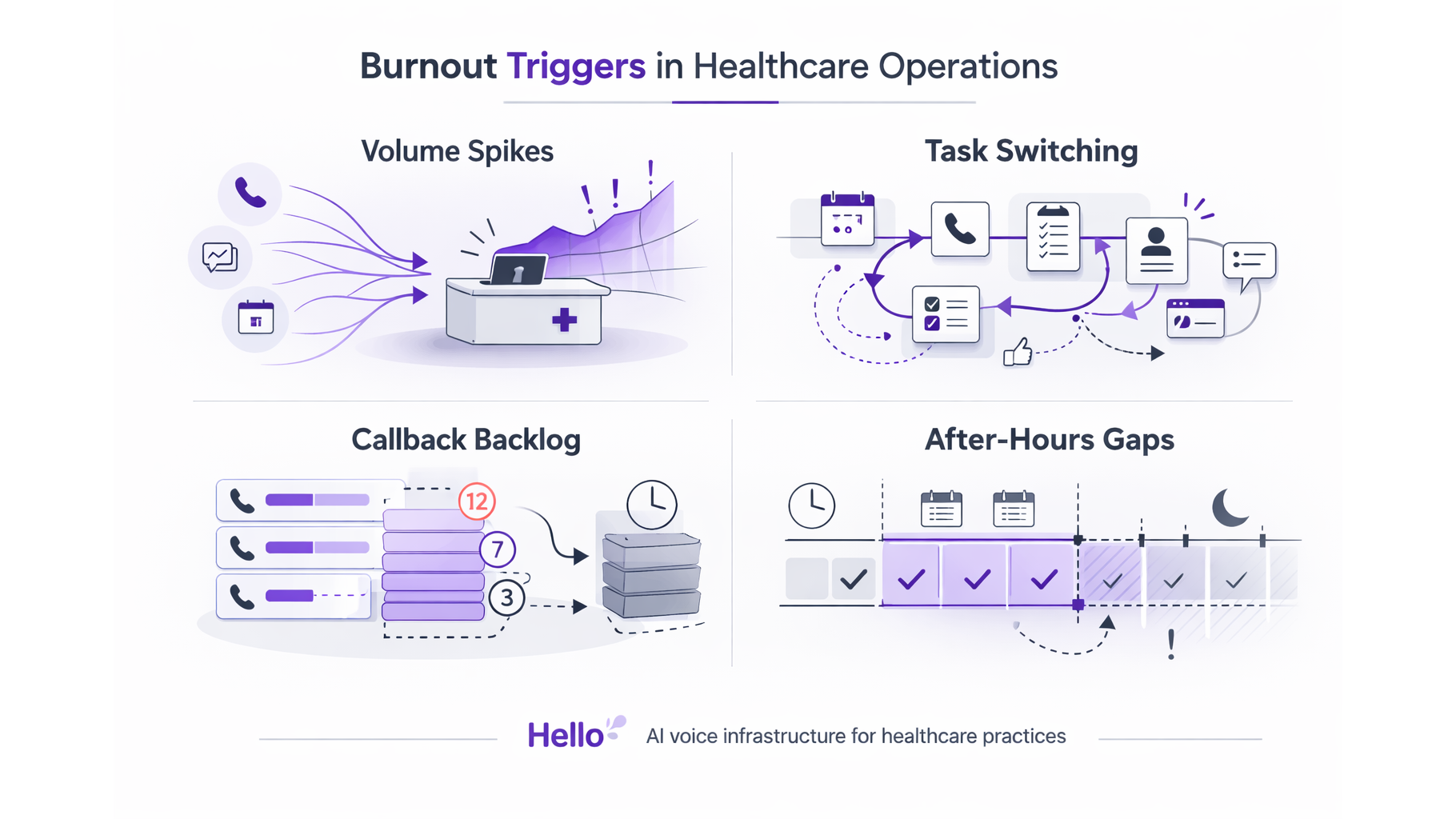
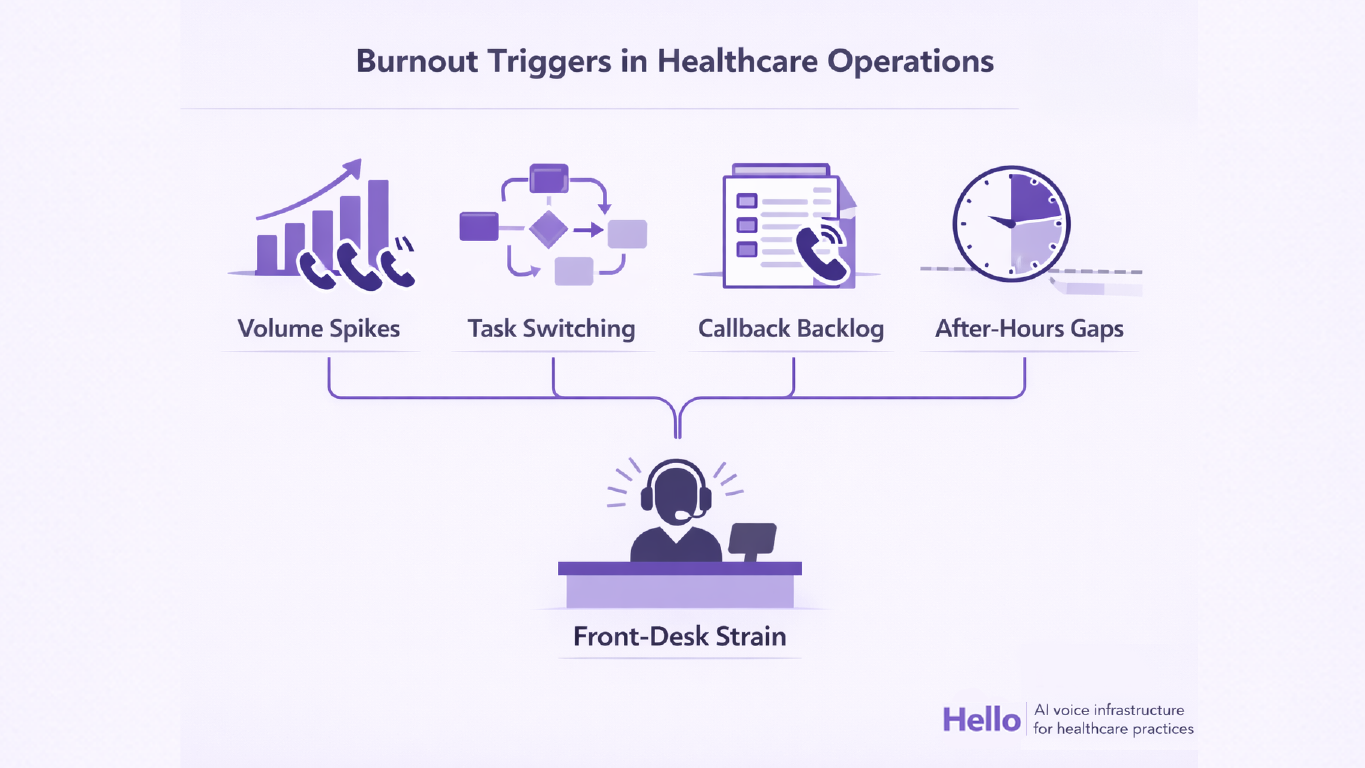
Burnout does not happen because of one bad day. It accumulates through four repeating triggers that compound over weeks and months.
1. Volume spikes with static staffing
Call volume in medical practices follows a "camel hump" pattern: heavy surges on Monday mornings, midday around 11:30 AM, and again between 4:00 and 5:30 PM. A practice with three receptionists that receives eight simultaneous calls at 9:05 AM sends five to voicemail. Staff cannot be sized for peak volume around the clock, so the overflow becomes backlog.
2. Task switching between phone and counter
The front desk receptionist checking in a surgical patient stops mid-conversation to answer a ringing phone. The in-person experience degrades. If they let the call ring, it goes to voicemail. Research on cognitive task switching shows that each interruption costs 15 to 23 minutes of productive focus, even for brief interruptions. In a medical office handling 60+ calls per day, the aggregate time lost to task switching can exceed 3 hours per receptionist. Over a 5-day work week, that is 15 hours of productive capacity destroyed by phone interruptions alone.
3. The callback backlog
Every missed call becomes a callback. Every callback takes 2 to 4 minutes of staff time, including re-dialing patients who do not answer, leaving voicemails, and logging the attempt in your practice management system (PMS). A backlog of 20 callbacks consumes over an hour of front desk time that cannot be spent answering today's incoming calls, which creates tomorrow's backlog. The cycle feeds itself. Practices running Dentrix or Eaglesoft can see this pattern in their call log reports: Monday morning callback queues that do not clear until Wednesday.
4. After-hours gaps with no coverage
Practices that close at 5:00 PM lose access to every patient who calls between 5:01 PM and 8:00 AM the next morning. This includes the 15 to 30% of daily call volume that arrives after business hours. Traditional answering services take messages during these hours but cannot book appointments, verify insurance, or collect deposits. The result: staff arrive to a queue of 15 to 25 messages every Monday morning, and the backlog cycle restarts before the day has started. See why your medical answering service may be losing you patients for a detailed breakdown of this gap.
How AI voice receptionists reduce burnout at each trigger point
An AI voice receptionist is not an automated phone tree. It is a telephony infrastructure layer that answers inbound calls using natural language processing (NLP), integrates with your EHR or PMS, and takes action on patient requests in real time.
Elastic capacity for volume spikes: Whether 1 patient or 50 patients call at the same time, every call is answered in under 5 seconds. There is no hold queue, no voicemail overflow, and no backlog. Hello's AI voice platform handles concurrent call volume that would require 8 to 10 human receptionists during peak hours. The system scales instantly with demand, so your Monday 9:00 AM surge gets the same response as a quiet Tuesday afternoon.
Removes the phone from task switching: When AI answers every call, your front desk staff are no longer interrupted by ringing phones. They can focus entirely on the patient standing in front of them. The phone stops being a source of stress and becomes background infrastructure.
Eliminates the callback backlog: Calls answered in real time do not generate callbacks. The AI books appointments directly into Dentrix, Eaglesoft, Nextech, or ModMed. It confirms insurance details, collects deposits via secure payment processing, and sends the patient a confirmation. Zero callbacks means zero backlog.
24/7 coverage without overtime: AI voice receptionists operate around the clock. After-hours calls that previously went to voicemail or a message-taking service are now fully resolved: appointments booked, deposits collected, clinical questions routed to on-call staff. Your team arrives in the morning to a clean queue, not a stack of messages.
For a detailed comparison of how these capabilities differ from traditional phone answering services, read the full breakdown of AI answering services vs. traditional medical answering services.
- 100% of calls answered in under 5 seconds, 24/7, 365 days a year
- Direct EHR integration with Nextech, ModMed, Dentrix, and Eaglesoft for real-time appointment booking
- Secure deposit collection at the time of booking to reduce no-shows
- Complex calls transferred to staff with full conversation context
See how Hello reduces front desk burnout for your practice →
AI voice receptionist vs. hiring staff vs. traditional answering service
The three most common approaches to reducing front desk phone burden have very different operational trade-offs.
| Factor | Hire Another Receptionist | Traditional Answering Service | AI Voice Receptionist |
|---|---|---|---|
| Volume spike handling | Limited by headcount | After-hours only | Elastic, unlimited concurrent calls |
| Task switching relief | Marginal (phones still ring) | None during business hours | Phones fully handled by AI |
| EHR integration | Manual data entry | None (message-taking only) | Direct write-back to Nextech, ModMed, Dentrix, Eaglesoft |
| Annual cost | $35K-$45K salary + benefits | $3,600-$9,600/year + per-minute overages | Implementation fee + monthly subscription |
| After-hours coverage | None (unless overtime) | Script-based message-taking | Full scheduling, deposit collection, clinical routing |
| Callback backlog impact | Reduced but not eliminated | Increases backlog (messages need follow-up) | Eliminates backlog entirely |
| HIPAA compliance | Training-dependent | Variable (many services lack BAAs) | BAA before go-live, TLS 1.2+, SOC 2 Type II |
For a deeper cost analysis of the traditional answering service column, see the true cost of a medical answering service in 2026.
What your staff actually does when AI handles the phones
When the phone stops ringing, your front desk team is not sitting idle. They are doing the work that requires human judgment and empathy.
Complex patient interactions: Explaining treatment plans, handling nervous patients, coordinating multi-step surgical scheduling that requires provider-specific availability. These are high-value tasks that AI cannot and should not replace.
Insurance verification and prior authorization: Following up on denied claims, calling insurance carriers, verifying coverage for upcoming procedures. These calls require patience, persistence, and the ability to navigate carrier phone trees.
In-person patient experience: When staff are not interrupted by the phone every 90 seconds, the check-in experience improves. Patients feel heard. Wait time perception improves. Online review scores go up.
Revenue recovery: Staff can focus on reactivating lapsed patients, confirming upcoming high-value procedures, and ensuring deposits are collected for scheduled consultations. When routine phone tasks are automated, practices typically recover 40%+ of front desk capacity that was consumed by repetitive call handling.
The framing matters: AI does not replace your team. It removes the 40+ daily interruptions that prevent your team from doing their best work. For a broader look at how practices evaluate security alongside these operational changes, see how secure an AI receptionist is for sensitive business calls.
FAQ
Will an AI voice receptionist replace my front desk staff? No. AI voice receptionists handle high-volume, repetitive phone tasks: scheduling, confirmations, prescription refill requests, after-hours inquiries. Your staff focuses on complex patient needs, insurance navigation, and in-person care. Practices using Hello typically redeploy front desk time rather than reduce headcount.
Does the AI integrate with my EHR or practice management system? Yes. Hello integrates with Nextech, ModMed, Dentrix, Eaglesoft, and other EHR/PMS platforms via HL7/FHIR protocols. Appointments are booked directly into your system with bi-directional sync, so there is no double-entry or manual transcription.
Is it HIPAA compliant? Hello signs a Business Associate Agreement (BAA) before go-live. All patient data is encrypted via TLS 1.2+ in transit and strong encryption at rest with post-quantum-ready key management. SOC 2 Type II audits are conducted annually. PHI (Protected Health Information) is automatically redacted from transcripts where appropriate.
What happens when the AI encounters a call it cannot handle? Complex clinical questions, upset patients, and edge-case scenarios are transferred to your staff in real time with full context from the conversation. The AI does not guess or improvise on clinical matters.
How quickly can we implement an AI voice receptionist? Hello uses a done-for-you implementation model. The system is configured, tested, and deployed by Hello's team. Implementation timelines vary by practice size and EHR integration complexity, but most practices go live within weeks, not months.
Front desk burnout is not solved by hiring more people or motivating your team harder. It is solved by removing the structural overload that causes it. When every call is answered before it rings at the front desk, your staff can do the work they were hired to do.